Even though there is little to question about Fernando Alonso's car development skills, last year many scoffed at his claims that his presence in McLaren-Mercedes gave them 6 tenths of a second increase in performance via his speed and car development abilities (some still scoff). This became a more dubious statement when the McLaren/Ferrari spy scandal ripped through F1 and it was revealed Alonso had access to some of the Ferrari data; it became an easy leap of logic to attribute their increase in performance to the data that was obtained, even though Alonso never trusted the data provided.
Well, maybe Alonso does know what he is taking about and simply expresses practical truths. In an interview with autosport.com, Renault technical director Bob Bell said exactly what Alonso thinks when discussing Alonso's chances in staying with the team for 2009. "We are not in this to make up the midfield - and I hope we have done enough to convince him to stay with us. I think we have. But I don't know. I think if you just look at the simple numbers – say the Q2 gap between our quickest driver and the quickest guy in Q2, we've gone from more than a second lap in Melbourne down to, we didn't get in here, but prior to this race it was down to four tenths."
Although his sportsmanship reputation has taken a beating, Fernando Alonso remains the best overall driver in Formula One.
Tuesday, September 30, 2008
Driver File: Sebastien Bourdais
 Scuderia Toro Rosso driver Sebastien Bourdais is a rookie in Formula One, but by no means is he inexperienced. He is truly one of great versatile drivers of this era and his talent should have landed him in F1 a long time ago.
He did well in lower formula and in 2002 claimed the championship in F3000, the old equivalent to the current GP2 Series. He was doing some testing for Arrows and Renault in 2002 and Renault were very much looking to get a French driver on the F1 driver roster. The top 3 names they were interested in where Bourdais, Franck Montagny and Romain Dumas. After his efforts Bourdais signed a contract to race with Arrows for the 2003 season, but the team went bankrupt and shut down their operation. There was an opportunity at Renault in which he pushed hard to get, but the test seat went to Montagny. It seemed like a good fit, a quality French driver in an Anglo-French team but it just was not to be and Bourdais felt snubbed.
So, for 2003 Bourdais signed with Newman-Haas to race in the United States in the Champcar World Series, a formula similar to Formula One. In that period of time, Sebastien became the most successful driver in that series' history. In 5 seasons, he amassed 31 wins and 4 straight championships. His win percentage was a mind boggling 43%.
So, for 2003 Bourdais signed with Newman-Haas to race in the United States in the Champcar World Series, a formula similar to Formula One. In that period of time, Sebastien became the most successful driver in that series' history. In 5 seasons, he amassed 31 wins and 4 straight championships. His win percentage was a mind boggling 43%.
In that period he continued to try and get into Formula One. However, he was snubbed each and every time. He was even snubbed a second time by Renault. Feeling jilted he had these words in regards to Renault, "I don't get any slap anymore from Renault, especially the last winter. I know I don't belong there. I don't expect anything. They've got their own policy. I'm not a part of their strategy. It's fair enough. I was just a little disappointed that they kind of nailed me like they did during the winter."
In November of 2006, he basically gave up his bid to get into Formula One. "I think it's over. It's frustrating but there are loads of talented drivers who never went to F1...one can always say it's unfair but that's F1, and it's never been fair." It would have been a miscarriage of justice if the talent of Bourdais sat on the F1 fence on the outside looking in. However not a month went by after those demoralizing words that he got the opportunity to test for Scuderia Toro Rosso. In the brief opportunity he got, he showed Toro Rosso that he belonged and was given the race driver for the 2008 season. He was obligated to finish his contract with Newman-Haas in Champcar for the 2007 season.
 2008 has been a learning experience and a trial for Bourdais. He has been outqualified by superstar teammate in the making Sebastian Vettel. At times he has driven well but he has not capitalized on the car's improved performance with race results. Bourdais is being outscored by Vettel 27 to 4. He has attributed the lack of pace to the car not suiting his driving style. The Toro Rosso car handling characteristics are low-speed oversteer and high-speed understeer; and according to him, since the French Grand Prix the car has been undriveable due to the aerodynamic package. Nevertheless, Bourdias will adjust and perform at the level that we are all accustom to.
 Monday, September 29, 2008
Badoer and Gene stay on as Ferrari test drivers
Ferrari has extended the contracts of test drivers Luca Badoer and Marc Gene. Badoer has been with the team since 1997 in the capacity of test driver, supporting the championship seasons of Michael Schumacher and Kimi Raikkonen. Even though Badoer's test mileage has diminished he clearly is a valued member of Ferrari. Marc Gene joined the Scuderia at the end of 2004. A quality tester in his own right, his on-track participation has been limited by testing restrictions and other race obligations.
Nevertheless, having these two quality test drivers will assist Ferrari for the foreseeable future as their current duo of Felipe Massa and Kimi Raikkonen have never been very strong development drivers. This will continue the necessary balance even within the restricted testing era.
Nevertheless, having these two quality test drivers will assist Ferrari for the foreseeable future as their current duo of Felipe Massa and Kimi Raikkonen have never been very strong development drivers. This will continue the necessary balance even within the restricted testing era.
Sunday, September 28, 2008
Singapore Grand Prix: Alonso wins masterfully!
 Renault's Fernando Alonso took his first win of the season and he took it giving the field a master class in driving and racecraft. The rain that was discussed all week never materialized and did not add any crazy surprises. After all seemed lost after a mechanical failure in qualifying and Alonso vocalizing his frustrations they rebounded in a way that reminded of their abilities that brought them titles in 2005 and 2006. Renault demonstrated the pace all weekend and have struck on a combination that is working very well for them at the moment. Moreover, Renault made some very aggressive strategy decisions, again reminiscent of their championship years. One of the things that was missing from Renault was their confidence. I would say with this win, they have gotten it back and may have gotten their double world champion driver to stay for 2009 in the process.
Felipe Massa had a disaster of the race in a pressure situation. Raikkonen crashed out after an average performance. It appears that the entire team is feeling the pressure and not giving Massa the support. The fact he was released into the pit lane and got penalized may have cost him the title. The problem with their automated pit release lights should have been solved as it was a problem at the European Grand Prix. Although he was not penalized at Valencia for being released too early in the pit lane, he was penalized here. I am very doubtful Ross Brawn would have allowed such errors.
In terms of points of interest:
1. Sebastien Bourdias. It was a complete waste again for Bourdais. The inconsistent performance and poor luck has hurt his ability to capitalize on the speed of the ToroRosso package. He finished 12th.
2. Attrition. Although the rain did not materialize, there were the expected crashes and reliability issues given the nature of street circuits. There were two safety car periods that helped Alonso but by no means was the reason for his win. However, there was an impact on the championship. Raikkonen with his crash has really made it difficult for himself in challenging Robert Kubica for 3rd in the title chase. Webber's problems certain does not help Red Bull's chances of beating their junior team Toro Rosso.
3. Heikki Kovalainen. Simply he failed in his bid to step up his performance which is a real disappointment. For a man driving a car the caliber of McLaren he has to extract more performance from the car. Yes, he has a win this season and its his first year at McLaren but I think Takuma Sato can get similar if not better results in that McLaren. Kovalainen finished 10th.
Notable performances are the Williams duo, Rosberg and Nakajima. They were having an excellent weekend and they followed through by having a great race. Both cars scored points today with Rosberg getting a career best 2nd place finish. Also, Toyota's Timo Glock drove quietly and impeccably to finish 4th.
Final Classification
1. Alonso
2. Rosberg
3. Hamilton
4. Glock
5. Vettel
6. Heidfeld
7. Coulthard
8. Nakajima
9. Button
10. Kovalainen
11. Kubica
12. Bourdais
13. Massa
14. Fisichella
15. Raikkonen
Fastest lap: Raikkonen, 1:45.599
Saturday, September 27, 2008
Singapore Grand Prix: Massa snatches pole position
On this historic Grand Prix weekend, Felipe Massa captures pole position for tomorrow's Singapore Grand Prix with a lap of 1:44.801. Massa clearly has assumed the role of team leader in terms of the championship battle and in terms of speed. Massa has placed himself in an ideal position and we will see if Kimi Raikkonen will give Massa a helping hand in terms of dealing with Lewis Hamilton. With Raikkonen qualifying 3rd, right behind Lewis Hamilton, Ferrari can employ some very interesting team strategy particularly if he can get past Hamilton on the open laps.
In terms of points of interest:
1. Sebastien Bourdais. He is not able to buy a break with a car that clearly has some pace. He could not get out of Q1 and has not done well on street circuits this year. Traditionally this circuit type has been his strong suit given the number of races and experience he had while in the Champcar World Series.
2. Attrition. We have seen some reliability and crashes without the much talked about rain. In qualifying we saw Fisichella hit the wall and we saw Alonso's car quit on him with a fuel pressure problem, which was a shame as he had a very strong weekend up to this point. He could have had a top 4 start given the pace he was showing.
3. Kovalainen. After showing some strength, he has continued his solid but non-descript performances in a car that clearly has plenty of speed. We will see how he fairs in the race and if he is heavy on fuel. He was only 13th in Saturday's final practice, so perhaps he was working on heavy fuel loads. He managed to qualify 5th.
In terms of points of interest:
1. Sebastien Bourdais. He is not able to buy a break with a car that clearly has some pace. He could not get out of Q1 and has not done well on street circuits this year. Traditionally this circuit type has been his strong suit given the number of races and experience he had while in the Champcar World Series.
2. Attrition. We have seen some reliability and crashes without the much talked about rain. In qualifying we saw Fisichella hit the wall and we saw Alonso's car quit on him with a fuel pressure problem, which was a shame as he had a very strong weekend up to this point. He could have had a top 4 start given the pace he was showing.
3. Kovalainen. After showing some strength, he has continued his solid but non-descript performances in a car that clearly has plenty of speed. We will see how he fairs in the race and if he is heavy on fuel. He was only 13th in Saturday's final practice, so perhaps he was working on heavy fuel loads. He managed to qualify 5th.
Notable performances: Nico Rosberg and Kazuki Nakajima of Williams. Traditionally Williams' cars have had very good mechanical grip. Hence, they generally perform well on street circuits where aerodynamics is not so prevalent. So here at Marina Bay circuit, the Williams duo has been strong all weekend and have qualified for the race in 9th and 10th respectively.
Friday, September 26, 2008
Hamilton and Alonso top historic practice sessions
Lewis Hamilton (1:45.518) emerged fastest for McLaren in the historic first practice session for the Singapore Grand Prix, as Formula One cars took to the track under floodlights for the first time ever. The Ferraris took second and third, with Felipe Massa just 0.080 seconds behind Hamilton and four tenths of a second ahead of teammate Kimi Raikkonen. Heikki Kovalainen completed the top four in the second McLaren, followed by BMW's Robert Kubica.
In session 2, Renault's Fernando Alonso topped the time sheets. The Renault driver outpaced the McLaren by 0.098 seconds, with Ferrari's Felipe Massa and McLaren's Heikki Kovalainen third and fourth, and Nico Rosberg impressing again for Williams in fifth. Hamilton was quickest for the majority of the session, swiftly moving ahead of early pacesetter Rosberg and then chipping away at his time for the next hour and steadily edging further ahead. Until Alonso's late lap, it looked like Hamilton was set to remain on top. But the Renault produced a 1:45.654 just before the chequered flag, after a spectacular lap on the super-soft tires.
Source: Autosport.com
In session 2, Renault's Fernando Alonso topped the time sheets. The Renault driver outpaced the McLaren by 0.098 seconds, with Ferrari's Felipe Massa and McLaren's Heikki Kovalainen third and fourth, and Nico Rosberg impressing again for Williams in fifth. Hamilton was quickest for the majority of the session, swiftly moving ahead of early pacesetter Rosberg and then chipping away at his time for the next hour and steadily edging further ahead. Until Alonso's late lap, it looked like Hamilton was set to remain on top. But the Renault produced a 1:45.654 just before the chequered flag, after a spectacular lap on the super-soft tires.
Source: Autosport.com
Singapore hit by storm, more rain expected
Last night, Singapore was hit with a heavy tropical storm as heavy rain lashed the city state for more than six hours. Further downpours are expected thoughtout the remainder of the weekend which could make life for the drivers more difficult during the first ever night race in the history of Formula One.
Source: F1 Technical
Source: F1 Technical
Wednesday, September 24, 2008
Singapore Grand Prix: Points of Interest
This weekend brings us the Singapore Grand Prix at the Marina Bay Circuit. It is the first grand prix in Singapore and the first ever Formula One race at night. Here are the things I will be looking at this weekend:
1. Sebastien Bourdais. Now that we have confirmed the pace of Toro Rosso, I will be looking to see if Sebastien Bourdais can translate the car's speed into actual results. He has been a victim of some bad luck and some reliability issues. Nevertheless, given his experience on street circuits during his time in Champcar, Bourdais should perform well. I expect a points finish.
2. Attrition. Given we are at a new street circuit and the night conditions will be very unfamiliar to many of the drivers and given that there is a chance for rain, it will be interesting to see how many cars finish the race. I think there will be several safety car periods.
3. Heikki Kovalainen. Kovalainen has made a respectable transition to the McLaren team but one of the areas that seems to have dogged him is his performance on street circuits. His best finish this year on street circuits is 4th, which ties his career best finish on street circuits (Canada). So, I will be interested to see if he can raise his game on street circuits. Given now it is later in the season, he is more experienced and his car is arguable the best on the grid, Kovalainen needs to step up and least get a podium finish.
Bring on Friday practice!
1. Sebastien Bourdais. Now that we have confirmed the pace of Toro Rosso, I will be looking to see if Sebastien Bourdais can translate the car's speed into actual results. He has been a victim of some bad luck and some reliability issues. Nevertheless, given his experience on street circuits during his time in Champcar, Bourdais should perform well. I expect a points finish.
2. Attrition. Given we are at a new street circuit and the night conditions will be very unfamiliar to many of the drivers and given that there is a chance for rain, it will be interesting to see how many cars finish the race. I think there will be several safety car periods.
3. Heikki Kovalainen. Kovalainen has made a respectable transition to the McLaren team but one of the areas that seems to have dogged him is his performance on street circuits. His best finish this year on street circuits is 4th, which ties his career best finish on street circuits (Canada). So, I will be interested to see if he can raise his game on street circuits. Given now it is later in the season, he is more experienced and his car is arguable the best on the grid, Kovalainen needs to step up and least get a podium finish.
Bring on Friday practice!
Driver File: Heikki Kovalainen
 McLaren-Mercedes driver, Heikki Kovalainen is as mild mannered as they come when in the cockpit. He is another in a line of successful Finnish drivers like Keke Rosberg, Mika Hakkinen and Kimi Raikkonen that you can call a "Flying Finn". Kovalainen was another of Renault's Development Drivers that ended up making the leap to Formula One.
In 2005, Kovalainen made the move to GP2, which is F1's primary feeder series. He did well and was steady with some very good performances that had him tied for the series lead in wins. Kovalainen faltered the final third of the season and finished 2nd in the GP2 championship to current Williams F1 driver, Nico Rosberg. After the season, Kovalainen was named Renault reserve and test driver for the 2006 season.
After spending a year testing and grooming with Renault, he was promoted to the race seat for 2007 that was vacated by Fernando Alonso and replacing a double World Champion in a championship winning car is not easy. It was no surprise that expectations for Kovalainen were very high and in his debut race, he was a huge disappointment. However, having the grace of 20/20 hindsight his mistakes was customary of a rookie and his performance was probably more indicative of the lack of performance that was in the R27 chassis. He was unduly criticized by the press and his team boss Flavio Briatore especially in light of the words of Renault's Director of Engineering, Pat Symonds in pre-season testing, "he is perhaps a little bit rusty after a year's testing, but I think it is a very natural thing that comes back to him. When we are at this stage next year and look back at 2007...we will see that Heikki had some fantastic races. I would not put it past him to win a race this year even as a rookie. It could happen. And we will also look at some spectacular mistakes, thinking why on earth did he do that? But that is part of the learning process."
There are certainly some things to like about Heikki; his humility, accountability and practicality and it started from day 1. In 2003, in his first tests for Renault he was rather frank about his skills, "I will be testing for Minardi next week, and then the RDD program will decide what the future holds. I would love to get into F1, and after this run I have the confidence that I could do a good job, but it may be a good idea to wait another year: there is still lots of work to do on my technical ability, and the physical side." Also after his afore mentioned debut in Australia, he was rather critical of himself.
In June, Briatore said, "a young driver, if the car is good, can achieve great results. If the car is difficult to driver it will be harder for him to grow." Surely an acknowledgement that the Renault was not the car it was in 2005 and 2006. Moreover, Kovalainen did develop with experience and an adjustment to his driving style. "At the beginning of the season I was attacking the corners a bit too much. I had a lot of confidence last year in the Michelin tires and in the R26 car. The combination gave a lot of confidence. You could drive it anywhere you wanted and brake where you wanted. It always turned into the corner, and the lap times were always competitive. I have calmed down a little my driving style this year. The combination of a lack of grip at the front of the car and the driving style was causing a lot of mistakes and inconsistent performances. I think when we improved the aerodynamics at the front of the car, that also helped me to realize the problem." After a shaky start, Kovalainen ended up out performing and outscoring his more experienced teammate and Renault veteran, Giancarlo Fisichella, 30-21. This included Kovalainen's first Renault's only podium of 2007 and a run of 7 straight points finishes from Silverstone to Fuji.
 Even though his performances picked up he was not confirmed at Renault and oddly enough he essentially got a promotion to McLaren, again replacing Fernando Alonso and teaming up with Lewis Hamilton. Kovalainen has been steady and has done well in making a transition to a brand new team. Kovalainen scored his first pole position this year and he even took his first ever win at the expense of Felipe Massa at the Hungarian Grand Prix. He continues to learn the car, the team and engineers methodically and continues to work on his technical skills, his physical fitness and mental approach. The team has extended his race deal to through 2009 demonstrating there belief that Kovalainen can continue to development and complete a dominant pair of drivers. With 4 races to go in the season, Kovalainen has a real shot of finishing 4th in the World Championship fight.
Next Driver File: Sebastien Bourdais
Tuesday, September 23, 2008
McLaren Belgian GP Appeal Denied
As was to be expected, the FIA has rejected McLaren's appeal against the penalty imposed on Lewis Hamilton at the Belgian Grand Prix at the Spa-Francorchamps circuit. The grounds for rejecting the appeal was that the appeal itself was inadmissible. This was going to be the initial
stumbling block for McLaren. There were questions on whether teams can actually appeal drive-through penalties - which technically was the punishment Hamilton received that took away his win. It was turned into a 25-second penalty because it was served in the final five laps of the race. So, it appears that they can not.
At least we can say that the process went quickly and we can focus on the remaining races knowing that a decision has been made and that the Singapore Grand Prix can be the major focus. Nevertheless, I still think McLaren and Hamilton had the victory taken away unjustly, but I knew the appeal was going to be for nothing...and it was. Bring on Singapore.
http://formulaoneamerica.blogspot.com/2008/09/hamilton-was-robbed-but-massa-will-win.html
http://www.autosport.com/news/report.php/id/70792
stumbling block for McLaren. There were questions on whether teams can actually appeal drive-through penalties - which technically was the punishment Hamilton received that took away his win. It was turned into a 25-second penalty because it was served in the final five laps of the race. So, it appears that they can not.
At least we can say that the process went quickly and we can focus on the remaining races knowing that a decision has been made and that the Singapore Grand Prix can be the major focus. Nevertheless, I still think McLaren and Hamilton had the victory taken away unjustly, but I knew the appeal was going to be for nothing...and it was. Bring on Singapore.
http://formulaoneamerica.blogspot.com/2008/09/hamilton-was-robbed-but-massa-will-win.html
http://www.autosport.com/news/report.php/id/70792
Monday, September 22, 2008
Marina Bay Circuit: F1 finally has a night race
 This weekend Formula One will enter the world of night racing by hosting its first ever night race at the Marina Bay Circuit in Singapore, and it is about time. In the United States, night racing has been a staple particularly in oval racing and at local race events. On a national level, NASCAR, Indy Racing League (IRL), American LeMans Series (ALMS), and Rolex Sportscar Series (GRAND-AM) all have night races and all seem to be very popular with the fans.
Night racing certainly gives a different sensory experience; you get to really see the exhaust flames, you see the sparks and you see lights shimmering off the cars which makes them look like 200 mph jewels; even the infield atmosphere with the crowd changes. Still, it is not like you do not see night races in Europe but you need to look to endurance races like the LeMans 24 hours, 24 Hours Nurburgring, 24 hours of Spa, etc. where the night aspects are unavoidable due to the obvious length of the races. Having been to endurance races in the US, I can imagine the atmosphere and experience would be rather similar in Europe.
I never really understood the lack of night racing in Europe in general for major series like Formula One, German Touring Car Masters (DTM), World Touring Car Championship (WTCC) and MotoGP. I always wondered if it was just a matter of tradition, a lack of desire or if there were real safety concerns around night races. For example, one of the primary concerns for the Singapore Grand Prix is what happens if it rains; will drivers be able to see with the combination of no lights on the cars, rain spray, and reflection from the lights used to illuminate the track on the spray. It is one of the unknowns even with all the simulator technology that F1 teams have at their disposal. It certainly is another challenge that the drivers and team have to potentially face.
The consensus is that a night race will be a benefit to the spectators as well as a boost to the visibility of Formula One. There were commerical concerns that the races in Asia and Australia made it more difficult for the traditional European fan base to watch on TV given the time difference. Bernie Ecclestone of Formula One Management (FOM) worked hard and continues to work to get more night races on schedule. Singapore came to F1 as a night race and in 2009 the Australian Grand Prix in Melbourne as well as the Malaysian Grand Prix in Sepang might be night races as well.
 In any case, the Singapore Grand Prix should be very exciting, not only because of the night aspects of the event and the unknown variables, but because we have another street circuit that looks rather interesting and challenging. Still, there is nothing like driver feedback after the first practice session. The scenery looks very appealing with a combination of historic and modern architecture as well as several bridges. The circuit is based in an area that is apart of a development plan for the area as a business and financial hub. So, it is truly in an urban center comparable if there was a grand prix in Times Sqaure, New York. As for the track layout itself, it is a 23-turn, 3.15 miles street circuit. It will keep the drivers very busy with a good combination of slow and fast corners with several opportunities to overtake with also some interesting features. In addition to the bridges, at Turn 19 the circuit actually runs under the main grandstand, a feature reminiscent of the tunnel at Monaco. If you wish to see a simulation of the new Marina Bay Circuit in Singapore, check out this simulation and track report from Red Bull-Renault driver Mark Webber as well as Scuderia Toro Rosso driver Sebastian Vettel.
 Saturday, September 20, 2008
Red Bull were handicapped by Renault, and Newey?
According to Red Bull founder Dietrich Mateschitz, Red Bull Racing's biggest handicap for not being 4th in the Constructors' Championship is engine supplier Renault. "Since a couple of months we have one of the best chassis' in Formula 1. But we also have a handicap, which is the Renault engine. Toro Rosso doesn't have that problem with Ferrari engines. That is the reason why Toro Rosso's combination is faster than Red Bull Racing." As everyone knows, Toro Rosso shares a similar chassis to that of Red Bull. It became rather clear in recent races that the chassis was very good, particularly in the last three Grand Prix.
Since Renault's return to Formula One in 2002 as a full constructor their engines never had the most horsepower; they were always reliable and had good drivability especially in their championship years. However, Renault has misjudged the engine freeze regulations and have been vocal about it. Flavio Briatore: "Renault have stuck to the letter of the current regulations on frozen engines, and we've been buggered: others didn't do that and are far ahead, while we suffer. It's not fair." Fair or unfair, it is Renault's fault for not exploiting the 'legal' aspects of engine development. It is a bit disappointing to see Renault not being innovative. It was talent and innovation that led them to Constructors' titles in 2005 and 2006. Perhaps they are indeed hampered by a smaller budget, something that they were rather proud of in the title years.
Frankly, it is surprising to hear that Renault CEO, the famous and very successful, tightfisted Carlos Ghosn increased the F1 budget by some 30-40% according to team principal Flavio Briatore. This leaves me no doubt that part of the increase is for "development" work on the engine. What is ironic about this situation is Renault was behind the idea of freezing engine development in the first. They originally proposed the idea to the FIA in a letter dated January 20th 2005, as part of a wider cost-cutting proposal. You would think they would have a more complete grasp at what was to happen when the FIA instituted the new regulations.
With all that said, what of Red Bull Chief Technical Officer, Adrian Newey? Let us look back at the Red Bull and Renault engine deal. Adrian Newey has been famous or infamous, depending on your viewpoint, for his tight aerodynamic packaging on his Formula One designs. His designs have largely caused some reliability issues for just about all the teams he designed cars for, particularly McLaren. However, his winning designs and winning record are unquestioned.
In late 2006, it was widely reported and understood that Adrian Newey had been pushing hard for a supply of Renault engines for the 2007 Red Bull chassis. He reportedly favored the Renault engine primarily because of its cooling characteristics, which would allow Newey to sculpt a more aggressive aerodynamic car. There had been numerous cooling issues with his designs at McLaren. Newey sought and pushed for what he thought was a sensible trade off given that the Renault engine just won another world title. Moreover, it would help resolve the reliability and cooling issues that plagued his designs. As Newey usually does, he eventually developed an excellent chassis that became reliable with the guiding hand of Red Bull Technical Director, Geoff Willis. However, do to the engine freeze that his suppliers Renault pushed for, his eventual strong chassis had an average engine that was still reliable and cooled efficiently, but was down on power.
Maybe perhaps if Newey was able to make more compromises in his design to make the car more reliable, they would have stuck with Ferrari power when making that fateful choice of what engine to choose. Perhaps Red Bull Racing would not only have a win, but could have had multiple wins.
Since Renault's return to Formula One in 2002 as a full constructor their engines never had the most horsepower; they were always reliable and had good drivability especially in their championship years. However, Renault has misjudged the engine freeze regulations and have been vocal about it. Flavio Briatore: "Renault have stuck to the letter of the current regulations on frozen engines, and we've been buggered: others didn't do that and are far ahead, while we suffer. It's not fair." Fair or unfair, it is Renault's fault for not exploiting the 'legal' aspects of engine development. It is a bit disappointing to see Renault not being innovative. It was talent and innovation that led them to Constructors' titles in 2005 and 2006. Perhaps they are indeed hampered by a smaller budget, something that they were rather proud of in the title years.
Frankly, it is surprising to hear that Renault CEO, the famous and very successful, tightfisted Carlos Ghosn increased the F1 budget by some 30-40% according to team principal Flavio Briatore. This leaves me no doubt that part of the increase is for "development" work on the engine. What is ironic about this situation is Renault was behind the idea of freezing engine development in the first. They originally proposed the idea to the FIA in a letter dated January 20th 2005, as part of a wider cost-cutting proposal. You would think they would have a more complete grasp at what was to happen when the FIA instituted the new regulations.
With all that said, what of Red Bull Chief Technical Officer, Adrian Newey? Let us look back at the Red Bull and Renault engine deal. Adrian Newey has been famous or infamous, depending on your viewpoint, for his tight aerodynamic packaging on his Formula One designs. His designs have largely caused some reliability issues for just about all the teams he designed cars for, particularly McLaren. However, his winning designs and winning record are unquestioned.
In late 2006, it was widely reported and understood that Adrian Newey had been pushing hard for a supply of Renault engines for the 2007 Red Bull chassis. He reportedly favored the Renault engine primarily because of its cooling characteristics, which would allow Newey to sculpt a more aggressive aerodynamic car. There had been numerous cooling issues with his designs at McLaren. Newey sought and pushed for what he thought was a sensible trade off given that the Renault engine just won another world title. Moreover, it would help resolve the reliability and cooling issues that plagued his designs. As Newey usually does, he eventually developed an excellent chassis that became reliable with the guiding hand of Red Bull Technical Director, Geoff Willis. However, do to the engine freeze that his suppliers Renault pushed for, his eventual strong chassis had an average engine that was still reliable and cooled efficiently, but was down on power.
Maybe perhaps if Newey was able to make more compromises in his design to make the car more reliable, they would have stuck with Ferrari power when making that fateful choice of what engine to choose. Perhaps Red Bull Racing would not only have a win, but could have had multiple wins.
Friday, September 19, 2008
"We are very confident that we won't be electrocuted"
Those are the words of Honda Racing test driver Alex Wurz after Honda completed their first major test of their KERS system at Jerez. Honda have already completed tests with KERS at Santa Pod and Silverstone, but Jerez was their first chance to run the system at length.
In an interview with Autosport.com he was asked if he could feel the difference KERS made to driving, "Yes. Thank god I feel it! If I wouldn't feel the 60 kilowatts, then I should not be a test driver. I have driven it before in a shakedown, the very first time the KERS was in the car at Santa Pod, and now it is interesting to drive it on the track. It has different effects on the car, and feeling how power output is interesting. It is all good. It is not that extreme, but you do feel it and it is quite nice. It works and, in the end, it is not rocket science. The car companies already have KERS in road cars, but the difficulty for F1 is getting it packaged."
Wurz was also asked how good Honda's KERS system was compared to the opposition: "It is impossible to answer because we don't know the output of the other teams, how they store the energy, so we cannot say. I would hope we are ahead, but there is no guarantee."
As I mentioned previously, given some of the struggles teams have had developing and integrating the KERS, and if Honda, Toyota, and BMW get their systems working properly, we can see a real competitive shift in 2009 if only for part of season. Particularly if there is a real performance advantage. Given the trusted feedback of a test driver the caliber of Alex Wurz, Honda might be on the climb back to respectability.
http://formulaoneamerica.blogspot.com/2008/09/kers-development-is-challenge.html
In an interview with Autosport.com he was asked if he could feel the difference KERS made to driving, "Yes. Thank god I feel it! If I wouldn't feel the 60 kilowatts, then I should not be a test driver. I have driven it before in a shakedown, the very first time the KERS was in the car at Santa Pod, and now it is interesting to drive it on the track. It has different effects on the car, and feeling how power output is interesting. It is all good. It is not that extreme, but you do feel it and it is quite nice. It works and, in the end, it is not rocket science. The car companies already have KERS in road cars, but the difficulty for F1 is getting it packaged."
Wurz was also asked how good Honda's KERS system was compared to the opposition: "It is impossible to answer because we don't know the output of the other teams, how they store the energy, so we cannot say. I would hope we are ahead, but there is no guarantee."
As I mentioned previously, given some of the struggles teams have had developing and integrating the KERS, and if Honda, Toyota, and BMW get their systems working properly, we can see a real competitive shift in 2009 if only for part of season. Particularly if there is a real performance advantage. Given the trusted feedback of a test driver the caliber of Alex Wurz, Honda might be on the climb back to respectability.
http://formulaoneamerica.blogspot.com/2008/09/kers-development-is-challenge.html
Formula One Testing: Jerez Summary
Teams went back to the test track this week in Jerez, Spain, deep within the sherry producing region of Spain.
On Day 1 (Tuesday), BMW-Sauber, Williams and Honda began the final testing session of the season with Renault, Toyota, McLaren, Toro Rosso, Red Bull expected to join on Day 2. Ferrari chose to test privately at Mugello and Fiorano starting Wednesday and Force India chose not to test. Notable events were that Williams and Honda tested their KERS system. For Williams it was their first test of the system. BMW-Sauber's Marko Asmer was quickest with a 1:20.189 lap.
On Day 2, the 8 teams scheduled were on track and again BMW-Sauber topped the sheets this time with official test driver Christian Klien. He focused on aerodynamic developments that will be used during the rest of the season. His time was 1:19.537. McLaren tested their KERS system for the first time with test driver Gary Paffett. Paffett did a check of the system, and tried some new aerodynamic developments. Williams tested their new 2009-specification rear end with Kazuki Nakajima at the wheel. Sebastian Vettel was at the wheel of a Red Bull-Renault getting more familiar with the team he will be racing for next year. The team focused on car setup and data acquisition.
On Day 3, Sebastian Vettel set the fastest time again at the wheel of a Red Bull-Renault. BMW-Sauber with Nick Heidfeld at the wheel set the 2nd fastest time, while working on the mechanical and aerodynamic set-up. It rained during the test, so they also worked on wet weather set-ups. Renault had Lucas Di Grassi testing various updates to the car and he set the 3rd fastest time of the day. McLaren continued their KERS development with long time tester, Pedro De la Rosa. Takuma Sato made his return to Formula One with Toro Rosso in which he worked on set-up to get a feel for the car and some aerodynamic tests which according to the team produced positive results.
On the final day of testing, McLaren-Mercedes tester, Pedro De la Rosa went quickest with a lap of 1:18.992. The focus of the program was to continue with KERS testing and some aerodynamic work. Honda and Williams continued their development work with the KERS. Renault's Lucas DiGrassi continued to work on aerodynamics and car set-up. Toyota had a productive day of testing with Timo Glock behind the wheel. Glock did aerodynamic comparisons in preparation for the races in Singapore and Japan as well as testing brakes and other systems.
As mentioned previously, Ferrari chose to test at Mugello and Fiorano. On Day 1, tester Luca Badoer worked on developing aerodynamic solutions for final 4 races. He also did some work on car set-up. Day 2 saw Raikkonen (Mugello) and Massa (Fiorano) in action where Raikkonen continued with the aerodynamic work. Felipe Massa carried out the shakedown of the cars the team will use at the Singapore Grand Prix. Day 3 saw Massa move to Mugello to complete the test program.
On Day 1 (Tuesday), BMW-Sauber, Williams and Honda began the final testing session of the season with Renault, Toyota, McLaren, Toro Rosso, Red Bull expected to join on Day 2. Ferrari chose to test privately at Mugello and Fiorano starting Wednesday and Force India chose not to test. Notable events were that Williams and Honda tested their KERS system. For Williams it was their first test of the system. BMW-Sauber's Marko Asmer was quickest with a 1:20.189 lap.
On Day 2, the 8 teams scheduled were on track and again BMW-Sauber topped the sheets this time with official test driver Christian Klien. He focused on aerodynamic developments that will be used during the rest of the season. His time was 1:19.537. McLaren tested their KERS system for the first time with test driver Gary Paffett. Paffett did a check of the system, and tried some new aerodynamic developments. Williams tested their new 2009-specification rear end with Kazuki Nakajima at the wheel. Sebastian Vettel was at the wheel of a Red Bull-Renault getting more familiar with the team he will be racing for next year. The team focused on car setup and data acquisition.
On Day 3, Sebastian Vettel set the fastest time again at the wheel of a Red Bull-Renault. BMW-Sauber with Nick Heidfeld at the wheel set the 2nd fastest time, while working on the mechanical and aerodynamic set-up. It rained during the test, so they also worked on wet weather set-ups. Renault had Lucas Di Grassi testing various updates to the car and he set the 3rd fastest time of the day. McLaren continued their KERS development with long time tester, Pedro De la Rosa. Takuma Sato made his return to Formula One with Toro Rosso in which he worked on set-up to get a feel for the car and some aerodynamic tests which according to the team produced positive results.
On the final day of testing, McLaren-Mercedes tester, Pedro De la Rosa went quickest with a lap of 1:18.992. The focus of the program was to continue with KERS testing and some aerodynamic work. Honda and Williams continued their development work with the KERS. Renault's Lucas DiGrassi continued to work on aerodynamics and car set-up. Toyota had a productive day of testing with Timo Glock behind the wheel. Glock did aerodynamic comparisons in preparation for the races in Singapore and Japan as well as testing brakes and other systems.
As mentioned previously, Ferrari chose to test at Mugello and Fiorano. On Day 1, tester Luca Badoer worked on developing aerodynamic solutions for final 4 races. He also did some work on car set-up. Day 2 saw Raikkonen (Mugello) and Massa (Fiorano) in action where Raikkonen continued with the aerodynamic work. Felipe Massa carried out the shakedown of the cars the team will use at the Singapore Grand Prix. Day 3 saw Massa move to Mugello to complete the test program.
Thursday, September 18, 2008
Will a Budget cap work?
The idea of a budget cap has been thrown around for several years and initially championed by former Jaguar Racing team principal Tony Purnell. In January, FIA president Max Mosley stated, "starting in 2009, there will be a cap on expenditure for all Formula One costs other than engines, drivers and expenditure exclusively for promotion and marketing." So with those words and the backing of the teams Formula One will have budget caps next season, but the exact details of how everything will work is still being figured out. The initial questions in regards to this cap are how much will teams be allowed to spend and on what? The proposed cap figures from the FIA and the FIA consultant Tony Purnell, one of the original backers of the idea, is as follows:
250 million USD for 2009 , approximately 200 million by 2010, and approximately 156 million in 2011. The proposed cap would not cover expenditures on engines, the new KERS, marketing costs or driver and team principal salaries. Although there seems to be no issues on what is not being capped, the reactions by team principals to the proposed cap figures have been mixed. Honda Racing CEO, Nick Fry has said, "next year's figures are workable, but Honda is a little concerned about the glide-path, which needs more discussion. By pushing the number too low, we may not only attract marginal operations but also alienate those at the top who want to develop high technology." Renault team principal, Flavio Briatore said "I already pay 40% less than the cap. If I want to keep to the limit then I need to spend more. It's nonsense." Although, this is before he publicly declared yesterday that Renault had increased their F1 budget by 30-40% amidst difficult economic conditions.
As an American that enjoys the National Football League and likes how the NFL manages their salary cap structure, I do wonder about the feasibility and impact of a cap in Formula One. In the NFL, there are 32 teams and each team is allowed to spend a fixed amount on player salaries. In 2008, the figure is 116 million USD; player salaries are the most expensive line item in a team's budget. Also, team owners can spend whatever they want in areas like marketing, investments, stadium infrastructure, etc. Moreover, the NFL shares its TV revenue equally. This helps to keep small market teams (Green Bay Packers, Jacksonville Jaguars) financially competitive with its bigger market brothers (New York Giants, New England Patriots).
In recent years the FIA has instituted a number of restrictions with the aim of reducing costs and keeping the independent teams alive and competitive (currently teams like Williams, Red Bull and Force India). The costs of operating a team are so high because car manufacturers have vast resources that squeeze out independent teams. The FIA has done what the NFL has done by putting restrictions on the most expensive line item, engines and engine development as well as restricting testing which has its pros and cons. In addition to testing and engines, the FIA have reduced the number of cars you can bring to the race, they have implemented a standard electronic control unit and they contracted a single tire supplier. Nevertheless, these measures help the smaller teams to a degree and have had only marginal success in controlling costs. Bigger teams would just shift expenses to other areas of development; for example investing heavily in building or acquiring wind tunnels, supercomputers and developing lubricant technology.
If Formua One is to have an effective cap system there has to be better revenue sharing. In F1, there is not a TV revenue sharing deal like the NFL's. F1's commercial aspects are governed by the Concorde Agreement which is a contract between the FIA, the Formula One teams and Formula One Administration. It dictates the terms by which the teams compete in races and take their share of the television revenues and prize money. This money is divided on a sliding scale. If the sport wanted to really save independent teams as well as control costs more effectively, they would give smaller teams an equal share of the TV money to help supplement team budgets. This current proposal is designed to regulate budgets in a way that can impact the livelihood of what amounts to the "working class" of F1; designers, engineers, factory staff, etc., particularly since the cap proposal is not a stable figure or one that incrementally increases; again it decreases and decreases drastically. It is a 42% decline in the budget cap figure in 2009 to 2011. Toyota's team president John Howett: "The one issue is how low the FIA wants it to go over time and the impact on people's livelihoods. That's the biggest concern I have." This proposal does not effect team principals or drivers as they can get paid whatever the team chooses, but some talented aerodynamacist who has more impact on the car has his salary capped. This is where there is another difference. In the NFL, the players (F1 equivalent would be drivers) have their salaries capped. Now, would it be more interesting if Ferrari did not manage their budget correctly and Sebastian Vettel became a "free agent"; and because BMW or Toyota managed their budget wisely they have the opportunity to get Vettel? I think that would be more interesting than having to worry about letting go some talented engineer for some second rate engineer because his or her salary puts a team over the budget cap.
In any event, it would not be the first time that FIA president Max Mosley let little fish die off. In late 2006, as a result of the engine development freeze, long time engine supplier Cosworth had to lay off 150 employees (40% of the staff). Mosley's comments at the time were, "there are bound to be redundancies. If you employ 1,000 people to put two cars on the grid 19 times a year, and you can do the same thing with 200 people, at the same level, well then, those 800 people, haven't got a job." This causality was a result of just an engine freeze on development. If the proposal goes in as planned, what causalities will there be for an aerodynamacist or engineer for a mid-level team like Red Bull? It would certainly hurt their competitiveness. Sharing the TV revenue equally would at least give teams an equal starting point of competitiveness, then the differences of better team management and getting/developing driving and engineering talent comes more into play as opposed to 2 teams simply fighting for the same sponsorship dollars.
So, as 2009 comes closer we will see what the final proposal will look like and see if it will help the independent teams and control costs effectively and keep F1 sustainable.
Wednesday, September 17, 2008
Driver File: Robert Kubica
 BMW-Sauber's Robert Kubica is the first Polish racing driver to compete in Formula One and my goodness he is mighty quick. His rise to stardom has been very quick and almost came out of nowhere. In late 2001, he was selected as a Renault development driver which paralleled their return to Formula One as a full manufacturer.
As Kubica developed a successful career in lower formula, it appeared that he had his first shot at participating in a Formula One Grand Prix in 2005 with Minardi at the Chinese Grand Prix as the team's third driver. However, it was not to be as Kubica did not have a superlicense and did not have the necessary testing mileage. Nevertheless, the wait would not be long for Kubica. After some testing with Renault, BMW-Sauber signed Robert as their test and reserve driver for the 2006 season. He would get an opportunity to drive the Formula One car at Grand Prix during practice sessions. During the signing, BMW Motorsport director Mario Theissen said, "we have been following Robert's progress and are very impressed by his performance in recent years. He has worked hard to achieve his success without major support. We are convinced that he has the potential and the will to make the leap into Formula One and are delighted to be able to give him the opportunity to do so. As the number three driver he will gain experience while at the same time helping the team develop the car."
Well, Theissen's words could not be more prophetic. After running as 3rd driver during part of the 2006 season, BMW-Sauber gave Kubica his racing opportunity when they replaced 1997 F1 Champion, Jacques Villeneuve due to ill effects suffered by Villeneuve in a crash. Kubica did not disappoint as he burst on the scene in beautiful fashion in a chaotic and memorable Hungarian Grand Prix, where he outqualified his more experienced teammate Nick Heidfeld. Although he was disqualified for being underweight after finishing 7th, it was clear that Kubica had the speed and talent to be a top level Formula One driver. In his 3rd start, he finished on the podium in another memorable race, the 2006 Italian Grand Prix thus becoming the first Polish driver to lead a Grand Prix and finish on the podium. His performances seem to light a fire under veteran F1 driver and teammate, Nick Heidfeld.
2007 seemed to be more of a learning year for Kubica as he struggled some to come to grips with having to switch to Bridgestone tires from the Michelin tires he was used to. By Kubica's own admission, he was worried that the tire switch was going to be problematic for him and that he had to switch his style. Kubica was outscored 61 to 39 by his newly rejuvenated teammate.
In 2008, a more experienced Kubica seemed to take more of a leadership role in the team and had no issues dealing with the ban on traction control. He wasted no time in showing  who was going to be the lead driver at BMW by putting his car on the front row in the Australian Grand Prix. He secured the first ever pole position for BMW-Sauber in Bahrain becoming the first Polish driver to achieve a pole position. Then, he secured BMW and his first ever Formula One win at the Canadian Grand Prix. Kubica has run over his teammate Nick Heidfeld in qualifying and currently sits 3rd in the World Championship Standings. Kubica looks ready to be really be number 1 material. BMW has recently confirmed that they are speaking with double World Champion and current Renault driver, Fernando Alonso and Kubica says he will welcome Alonso. Given Kubica's development I would say Kubica is not near his peak. Even with the potential addition of Alonso, Kubica can take on any challenge.
Teams seek to equal engine performance
Excerpts from Autosport.com
"Behind-the-scenes efforts by teams to make Formula One engine performance more equal are set to be ramped up in the wake of Scuderia Toro Rosso's shock victory in the Italian Grand Prix, autosport.com has learned. Sebastian Vettel caused a major surprise when he became F1's youngest ever winner at Monza, with a performance that highlighted the differences between his Ferrari-powered STR3 and the Renault-powered car of sister team Red Bull Racing.
The result has provided further evidence to those who believe that there is now a genuine performance gap between different engines on the grid. A number of manufacturers - especially Renault – have already spoken out in claiming that they have lost out by not developing their power-unit under F1's current engine freeze. Although making improvements to the engines is not allowed, manufacturers can change parts as the FIA's discretion if it reduces costs or improves reliability. Such revisions can also have the added benefit of lifting performance. Further steps forward can be made from improved fuel and lubricants, and the airbox and exhaust design.
Sources have told autosport.com that a number of teams are so unhappy with the situation – which could leave them down on power until 2013 if the rules do not change – that they are now lobbying the FIA behind the scenes to try and level the playing field for next year."
http://www.autosport.com/news/report.php/id/70682
It was only a matter time, especially since you saw equal chassis have a difference in performance. That is why I was looking at the speed trap differences particularly on these last two tracks (Spa and Monza). The horsepower tracks were going to expose the difference where people can not claim downforce level settings or poor aerodynamics. Also, it is of no surprise that it is Renault that is complaining the most as they have been passed by Toro Rosso and their customer team in terms of engines is Red Bull. Again, the Toro Rosso chassis which has engine power from Ferrari, is essentially a Red Bull chassis.
"Behind-the-scenes efforts by teams to make Formula One engine performance more equal are set to be ramped up in the wake of Scuderia Toro Rosso's shock victory in the Italian Grand Prix, autosport.com has learned. Sebastian Vettel caused a major surprise when he became F1's youngest ever winner at Monza, with a performance that highlighted the differences between his Ferrari-powered STR3 and the Renault-powered car of sister team Red Bull Racing.
The result has provided further evidence to those who believe that there is now a genuine performance gap between different engines on the grid. A number of manufacturers - especially Renault – have already spoken out in claiming that they have lost out by not developing their power-unit under F1's current engine freeze. Although making improvements to the engines is not allowed, manufacturers can change parts as the FIA's discretion if it reduces costs or improves reliability. Such revisions can also have the added benefit of lifting performance. Further steps forward can be made from improved fuel and lubricants, and the airbox and exhaust design.
Sources have told autosport.com that a number of teams are so unhappy with the situation – which could leave them down on power until 2013 if the rules do not change – that they are now lobbying the FIA behind the scenes to try and level the playing field for next year."
http://www.autosport.com/news/report.php/id/70682
It was only a matter time, especially since you saw equal chassis have a difference in performance. That is why I was looking at the speed trap differences particularly on these last two tracks (Spa and Monza). The horsepower tracks were going to expose the difference where people can not claim downforce level settings or poor aerodynamics. Also, it is of no surprise that it is Renault that is complaining the most as they have been passed by Toro Rosso and their customer team in terms of engines is Red Bull. Again, the Toro Rosso chassis which has engine power from Ferrari, is essentially a Red Bull chassis.
Monday, September 15, 2008
F1 Shareholder files for Bankruptcy
Quoted from F1 Technical
"In the midst of a financial crisis on all markets, Lehman Brothers, the fourth-largest US investment bank, has filed for bankruptcy protection, dealing a blow to the fragile global financial system. Lehman Brothers is part of the CVC group that own 16.8% of Formula One shares.
Lehman was forced into bankruptcy after Barclays Plc and Bank of America Corp. abandoned takeover talks yesterday and the company lost 94 percent of its market value this year. Today, the stock dropped a further 92%, making it virtually invaluable.Earlier on, the American government had decided to take over Fannie Mae en Freddie Mac but have opted against that option for Lehman Brothers. It still remains to be seen how the value will evolve and if whether anyone would allow the bank to go bankrupt completely.It is also not clear how such would influence F1, but it is clear that interested parties may try to take over the stock owned by the troubled bank."
More details: bloomberg.com.
"In the midst of a financial crisis on all markets, Lehman Brothers, the fourth-largest US investment bank, has filed for bankruptcy protection, dealing a blow to the fragile global financial system. Lehman Brothers is part of the CVC group that own 16.8% of Formula One shares.
Lehman was forced into bankruptcy after Barclays Plc and Bank of America Corp. abandoned takeover talks yesterday and the company lost 94 percent of its market value this year. Today, the stock dropped a further 92%, making it virtually invaluable.Earlier on, the American government had decided to take over Fannie Mae en Freddie Mac but have opted against that option for Lehman Brothers. It still remains to be seen how the value will evolve and if whether anyone would allow the bank to go bankrupt completely.It is also not clear how such would influence F1, but it is clear that interested parties may try to take over the stock owned by the troubled bank."
More details: bloomberg.com.
Sunday, September 14, 2008
Italian Grand Prix: Vettel Wins Historic Race
 In a very wet and historic Italian Grand Prix we saw Toro Rosso's Sebastian Vettel take the win in dominant fashion. It was his first win, it was Toro Rosso's first win, and he became the youngest Grand Prix winner in history breaking Fernando Alonso's record. Earlier in the weekend Vettel also became the youngest driver to sit on pole position.
The race started under the safety car but quickly peeled off to allow the real racing to begin. We saw Vettel's fine skills in wet conditions and was left unchallenged by any of the other drivers. Lewis Hamilton finished 7th but demonstrated wet weather driving skills reminiscent of the late Ayrton Senna. Hamilton's chief rival, Felipe Massa finished 6th and did nothing to ruin his title chances in variable conditions, which is not his strength. The title chase narrows to just a single point with the appeal of the Belgian Grand Prix penalty against Hamilton looming in the background.
In terms of points of interest:
1. Speed differential. It is difficult to assess given the wet conditions but Ferrari power was strongly represented in the speed traps. However, to see the Red Bull Renault in the speed traps with an engine that everyone admits is down on power, we know the chassis has a very good aerodynamic package. As we can see with the Toro Rosso team who share a similar chassis to Red Bull, the benefits of engine power in this engine freeze period is critical.
2. Renault. Renault and Fernando Alonso seemed rather bleak about their chances. Their muted optimism was that there was rain for the race. It has be rather frustrating that they are not making the development gains necessary to challenge consistently at the front and to see Toro Rosso go from a tail ender to the front of grid in the course of one season, which is near impossible. Nevertheless, Alonso and Nelson Piquet made good with the situation and have maintained an upward performance curve. Alonso was one of the first to go to the standard wet tire from the extreme wets and benefited from the strategy choice. Piquet performed well although he had a few moments and both had 1 stop strategies. They finished 4th and 10th respectively.
3. Nick Heidfeld. BMW seem to have lost there way or have extracted what they can out of the F1.08 chassis. Moreover, Heidfeld looks like he has extracted as much as he can out of himself. With BMW openly waiting for Alonso to make a decision about a future drive, Heidfeld is not doing enough to save his job.
Other drives worth noting are Williams' Nico Rosberg and Ferrari's Kimi Raikkonen. After a good first portion of the race, Rosberg fell off the face of the earth. He encountered a fuel rig problem and never seemed to recover. He finished behind his teammate Nakajima who finished 12th. At this point, Rosberg (14th) is too inconsistent for my taste. Raikkonen's race was just bad. He languished in the midfield the entire race. Although he came on at the end to set the fastest lap of race, I think it is a question of motivation and the new extension will not help matters. He finished 9th.
Results:
1. Vettel
2. Kovalainen
3. Kubica
4. Alonso
5. Heidfeld
6. Massa
7. Hamilton
8. Webber
9. Raikkonen
10. Piquet
11. Glock
12. Nakajima
13. Trulli
14. Rosberg
15. Button
16. Coulthard
17. Barrichello
18. Bourdais
19. Sutil
Fastest Lap: Raikkonen, 1:28.047
Saturday, September 13, 2008
Vettel has snatched pole position!
Toro Rosso's Sebastian Vettel has literally stormed his way to his and Toro Rosso's first pole position for tomorrow Italian Grand Prix. Not only has Toro Rosso and Vettel on pole, but Sebastien Bourdais will start on the second row!
As mentioned during the Belgian Grand Prix weekend, Tthey have confirmed that their package is for real. The chassis is good and Ferrari power has given them an edge that should help them in the final races of the season, as now they are in a position to challenge for 6th in the Constructor's Title. Is it possible that they can win a race this season? Will they continue on with the huge uptick in pace in the remaining races?
As mentioned during the Belgian Grand Prix weekend, Tthey have confirmed that their package is for real. The chassis is good and Ferrari power has given them an edge that should help them in the final races of the season, as now they are in a position to challenge for 6th in the Constructor's Title. Is it possible that they can win a race this season? Will they continue on with the huge uptick in pace in the remaining races?
Friday, September 12, 2008
Sutil leads in wet session, Raikkonen back on top
Quoted and edited from Autosport.com
Force India driver Adrian Sutil led in a very wet opening practice of the Italian Grand Prix. Rain fell for most of the morning at an extremely gloomy Monza, with the track damp initially and only a handful of teams choosing to go out before further showers prevented quick times being set. Although the precipitation did stop briefly, the track had no chance to dry before a massive downpour began in the final 20 minutes, convincing all those who had ventured out for some wet practice to return to shelter in the pits - although even the garage floors started getting damp as the pitlane drains overflowed. The session was ultimately officially red-flagged with four minutes remaining due to the severity of the rain, although by that point no-one had attempted to leave the pits for nearly a quarter of an hour.
The reigning champion, Kimi Raikkonen beat the BMWs of Robert Kubica and Nick Heidfeld to the top spot, with points leader Lewis Hamilton taking fourth for McLaren in the 2nd Session of Friday practice. Practice began on a damp track, but unlike the first session, this time conditions steadily improved. Toro Rosso's Sebastien Bourdais was the first man to switch to slick tires after 20 minutes, and although at first he was five seconds off the pace, within six laps he was matching and then beating early pacesetter Raikkonen.
BMW-Sauber's Robert Kubica led the way until the final flurry of soft tire runs, when Raikkonen returned to the front with a 1:23.861, 0.07 seconds quicker than Kubica. With none of the other front-runners improved on their final flying laps, Raikkonen remained on top until the end, ahead of the BMWs, Hamilton and Williams' Nico Rosberg.
http://www.autosport.com/news/report.php/id/70493
http://www.autosport.com/news/report.php/id/70501
Force India driver Adrian Sutil led in a very wet opening practice of the Italian Grand Prix. Rain fell for most of the morning at an extremely gloomy Monza, with the track damp initially and only a handful of teams choosing to go out before further showers prevented quick times being set. Although the precipitation did stop briefly, the track had no chance to dry before a massive downpour began in the final 20 minutes, convincing all those who had ventured out for some wet practice to return to shelter in the pits - although even the garage floors started getting damp as the pitlane drains overflowed. The session was ultimately officially red-flagged with four minutes remaining due to the severity of the rain, although by that point no-one had attempted to leave the pits for nearly a quarter of an hour.
The reigning champion, Kimi Raikkonen beat the BMWs of Robert Kubica and Nick Heidfeld to the top spot, with points leader Lewis Hamilton taking fourth for McLaren in the 2nd Session of Friday practice. Practice began on a damp track, but unlike the first session, this time conditions steadily improved. Toro Rosso's Sebastien Bourdais was the first man to switch to slick tires after 20 minutes, and although at first he was five seconds off the pace, within six laps he was matching and then beating early pacesetter Raikkonen.
BMW-Sauber's Robert Kubica led the way until the final flurry of soft tire runs, when Raikkonen returned to the front with a 1:23.861, 0.07 seconds quicker than Kubica. With none of the other front-runners improved on their final flying laps, Raikkonen remained on top until the end, ahead of the BMWs, Hamilton and Williams' Nico Rosberg.
http://www.autosport.com/news/report.php/id/70493
http://www.autosport.com/news/report.php/id/70501
Thursday, September 11, 2008
KERS development is a challenge
It is clear that the introduction of the Kinetic Energy Recovery System (KERS) is something that will test the Formula One world in regards to technology, safety, implementation and integration. However, the scope of the challenge is evolving everyday. The system is set for introduction in 2009, but is not mandatory.
Today, Ferrari's engine technical director Gilles Simon says they are struggling with KERS development. "The Kinetic Energy Recovery System is a complex subject, which finds us dealing with a lot of new and complicated areas, while ensuring that we still devote all necessary efforts into continuing our usual development program on the current year car. It will be really challenging to run this system next year. We are learning every day, but we are struggling and I think that all teams will struggle to run the new system reliably right from the opening race of the 2009 season."
Overall, the KERS has seen its share of teething problems. Ferrari and Simon have now voiced their struggles and earlier this summer BMW-Sauber and Red Bull Racing had problems when a BMW-Sauber mechanic was struck to the ground by an electrical shock and Red Bull had a fire in their factory due to testing of a new battery for KERS. There have been calls for the introduction of the KERS to be delayed, but Honda, Williams and BMW-Sauber, despite the incident earlier in the summer, have been vocal in their opposition to any delay.
Honda has encountered few problems with their KERS development and Williams and BMW-Sauber echo similar sentiments of the system being a welcomed technical challenge; Toyota's feelings have been mixed. Toyota team president John Howett was unsure if it would be ready in time but those comments were later countered by engine chief Luca Marmorini who expressed confidence in the staff that things will be done on time for the first race of 2009. "Our development is focused on producing a KERS system which is appropriate for Formula One and brings performance increase. We have a group dedicated to this and we trust them to deliver." Ferrari's revelation that they too are struggling is a bit surprising given the level of talent that resides at Maranello, but at the same time not surprising given the research and development aspects of developing such a system. Teams like Honda, BMW and Toyota can call on a lot of resources and some experience with this sort of technology whereas Ferrari can not.
Renault's Flavio Briatore and McLaren's Ron Dennis have been forces opposed to the introduction schedule for the KERS, which makes you wonder about the resources available to Renault F1 even though Renault do hybrid R&D with their partner Nissan. McLaren's call for a delay in the KERS implementation is more surprising than finding out Ferrari is struggling because McLaren houses its own automotive and electronics companies within its technology center, and has the resources of Mercedes-Benz plus talented staff. It makes you wonder the disadvantage a team like McLaren and Renault will be in if teams like Honda, Toyota, and BMW get this system working properly and McLaren and Renault have to delay. If Ferrari has to delay as well, we can see a real competitive shift in 2009 if only for part of season; and would that be bad for Formula One? If the system is safe for drivers, marshals, and spectators, then more power to the teams that can get it to work.
Today, Ferrari's engine technical director Gilles Simon says they are struggling with KERS development. "The Kinetic Energy Recovery System is a complex subject, which finds us dealing with a lot of new and complicated areas, while ensuring that we still devote all necessary efforts into continuing our usual development program on the current year car. It will be really challenging to run this system next year. We are learning every day, but we are struggling and I think that all teams will struggle to run the new system reliably right from the opening race of the 2009 season."
Overall, the KERS has seen its share of teething problems. Ferrari and Simon have now voiced their struggles and earlier this summer BMW-Sauber and Red Bull Racing had problems when a BMW-Sauber mechanic was struck to the ground by an electrical shock and Red Bull had a fire in their factory due to testing of a new battery for KERS. There have been calls for the introduction of the KERS to be delayed, but Honda, Williams and BMW-Sauber, despite the incident earlier in the summer, have been vocal in their opposition to any delay.
Honda has encountered few problems with their KERS development and Williams and BMW-Sauber echo similar sentiments of the system being a welcomed technical challenge; Toyota's feelings have been mixed. Toyota team president John Howett was unsure if it would be ready in time but those comments were later countered by engine chief Luca Marmorini who expressed confidence in the staff that things will be done on time for the first race of 2009. "Our development is focused on producing a KERS system which is appropriate for Formula One and brings performance increase. We have a group dedicated to this and we trust them to deliver." Ferrari's revelation that they too are struggling is a bit surprising given the level of talent that resides at Maranello, but at the same time not surprising given the research and development aspects of developing such a system. Teams like Honda, BMW and Toyota can call on a lot of resources and some experience with this sort of technology whereas Ferrari can not.
Renault's Flavio Briatore and McLaren's Ron Dennis have been forces opposed to the introduction schedule for the KERS, which makes you wonder about the resources available to Renault F1 even though Renault do hybrid R&D with their partner Nissan. McLaren's call for a delay in the KERS implementation is more surprising than finding out Ferrari is struggling because McLaren houses its own automotive and electronics companies within its technology center, and has the resources of Mercedes-Benz plus talented staff. It makes you wonder the disadvantage a team like McLaren and Renault will be in if teams like Honda, Toyota, and BMW get this system working properly and McLaren and Renault have to delay. If Ferrari has to delay as well, we can see a real competitive shift in 2009 if only for part of season; and would that be bad for Formula One? If the system is safe for drivers, marshals, and spectators, then more power to the teams that can get it to work.
Italian Grand Prix: Points of Interest
This weekend's upcoming Italian Grand Prix at the historic Monza circuit is going to be special. The title chase has tightened up dramatically given the controversial events that occurred last weekend at Spa-Francorchamps, with Lewis Hamilton being given a 25 second penalty costing him the win. We are all eager to watch the ensuing battle between McLaren and Ferrari; however there will be other points of interests that I will be following as well.
1. Speed differential. Just like Spa, Monza is a true horsepower circuit. 75% of the lap at Monza is full throttle. I again will be curious to see the difference in speed trap numbers especially since teams will be running with very little downforce on the car.
2. Renault. They have picked up their pace and the performance of the package has gotten better throughout the year. Given that they had an encouraging test at Monza in preparation for the Belgian and Italian Grand Prix and had a good result at Spa, I would like to see if they can continue the performance uptick; this time with both cars. Although I think Toyota will still beat Renault, it will be positive to see Renault perform well.
3. Nick Heidfeld. He has been under pressure to perform recently after being outperformed all season by his teammate Robert Kubica. There are rumors that Alonso is set to go to BMW and replace Heidfeld. Heidfeld is fighting for his seat and maybe fighting to stay in Formula One. Given his performance at Spa, he did all that he could to make the case for himself, but I am not convinced and I do not think BMW is either. I will be watching to see how he performs in this race.
1. Speed differential. Just like Spa, Monza is a true horsepower circuit. 75% of the lap at Monza is full throttle. I again will be curious to see the difference in speed trap numbers especially since teams will be running with very little downforce on the car.
2. Renault. They have picked up their pace and the performance of the package has gotten better throughout the year. Given that they had an encouraging test at Monza in preparation for the Belgian and Italian Grand Prix and had a good result at Spa, I would like to see if they can continue the performance uptick; this time with both cars. Although I think Toyota will still beat Renault, it will be positive to see Renault perform well.
3. Nick Heidfeld. He has been under pressure to perform recently after being outperformed all season by his teammate Robert Kubica. There are rumors that Alonso is set to go to BMW and replace Heidfeld. Heidfeld is fighting for his seat and maybe fighting to stay in Formula One. Given his performance at Spa, he did all that he could to make the case for himself, but I am not convinced and I do not think BMW is either. I will be watching to see how he performs in this race.
Wednesday, September 10, 2008
Driver File: Felipe Massa
 Felipe Massa came into Formula One in 2002 as a raw talent that caught the eye of team principal Peter Sauber. Sauber has always evaluated talent well, Massa is no exception. In his very test for Sauber, then test team manager Jacky Eeckelaert commented, "the boy is very fast." Nevertheless, after securing a seat at Sauber, Massa developed a reputation of being very quick but a crasher. This may have been a result of his self-proclaimed aggressive style. "I would rather make some mistake than not try." However, it was rather prophetic that technical director William Rampf professed, On a quick lap, Felipe is quicker than Kimi," said Rampf. "He is very talented and can go for a quick lap without any problem. We compared the first tests of Felipe and Kimi, and they are very similar. In terms of feedback they are also the same." It is interesting to see the results that Raikkonen and Massa have racked up in their Ferrari careers. Although he surely demonstrated the speed in 2002, this style is what probably got him dumped and rideless leaving him the option to test driver for Ferrari in 2003, which in reality is probably was not all that bad, given that you test for a world championship team and partner a legend in Michael Schumacher.
Massa gained valuable experience testing at Ferrari particularly on understanding the technical side of F1. He remarked of his time there "I have learnt and am learning a lot," he said. "For me, Ferrari is proving to be an incredible school. Working with Michael (Schumacher), Rubens (Barrichello) and Luca (Badoer, his fellow tester) is like going to university. The experience I am acquiring this year is very important, especially as I go to all the races and attend all the meetings. The more time I spend with the team the better it is for me."
After Massa's schooling at Ferrari in 2003, he returned to Sauber in 2004 and 2005. He performed well against his more senior teammates, then highly-rated Giancarlo Fisichella (2004) and former F1 World Champion, Jacques Villeneuve. Then in 2006 he got the opportunity to drive for Ferrari in a race capacity. He supported Michael Schumacher in his bid for another world title but one can see that Massa had the raw speed to challenge Schumacher. He claimed 3 poles and 2 victories which included his maiden win from pole in Turkey. He finished 3rd in the title chase in 2006.
 In 2007, Massa was the unknown soldier in the epic battle that occurred between McLaren, Ferrari, Raikkonen, Hamilton and Alonso but amassed 6 poles and 3 wins nonetheless. As time progressed Massa has reconfirmed the words of Rampf and Eeckelaert all those years ago. He has collected poles (13), race wins (10) and fast laps (9) in his 48 race Ferrari career. Granted he is in top equipment but a 21% win percentage is pretty good.
In 2008, it appears he has fully learned to harness his aggressive style and has made it effective in an era where consistency and reliability reign supreme. He has made a remarkable comeback after scoring zero points in the first two races in less than impressive fashion. There were even rumors that Massa was set to be replaced. He erased an 11 deficit to World Champion teammate Raikkonen and turned into a 17 point advantage. Massa has placed himself in prime position to attack for a world championship against Lewis Hamilton and has erased a 14 point margin after the first 2 races to 2 points with 5 races to go. If Massa can pull it off, he would be the first Brazilian Formula One Champion since the late great Ayrton Senna in 1991.
Tuesday, September 9, 2008
Monza: Formula One Soul
 The historic Autodromo Nazionale Monza is nestled in the Parco di Monza just outside of Monza, Italy. It is a true relic of race tracks with the memories of an old sage. The site has three tracks, 3.6 mile Grand Prix circuit, the 1.5 mile Junior track and a decaying and defunct 2.6 mile high speed oval with steep bankings.
Built in 1922, Monza was only the 3rd permanent race track in the world at the time with the others being the famed Brooklands (no longer in racing use) and Indianapolis Motor Speedway. The track has been renovated and re-profiled several times in its history but the basic layout of the Grand Prix circuit is essentially the same.
It has been home to many memorable F1 moments, both tragic and joy-filled. In 1961, Wolfgang von Trips died as well as 13 others after cartwheeling into the crowd after clashing with Jim Clark. In 1976, Niki Lauda returned to racing just a few weeks after his near fatal accident that left him disfigured by burns at the glorious but notorious Nurburgring. In 1988, a few weeks after Enzo Ferrari's death, Ferrari pulled off a magical 1-2 finish after McLaren's Ayrton Senna misjudged a pass on a back marker with only a few laps to go and ended up in the sand trap. It was McLaren's only loss of the 1988 season. In 2006, Monza was the place that it was announced that 7 times F1 World Champion Michael Schumacher was retiring, after another virtuoso win. His eventual heir-apparent, Kimi Raikkonen stood next to Schumacher on podium.
 Monza has a simple layout but it is a difficult and very fast circuit. It puts a premium on engine performance and aerodynamic efficiency. Drivers are on the throttle 75% of the time but this is countered by some slow chicanes which will give engines and brakes a workout, so reliability is also a must. Coming to Monza is always a highlight, especially when the you see the sea of Tifosi, a common reference to the scores of Ferrari fans with their customary red attire and prancing horse flags. Teams recently completed a test, so data for teams should be very reliable and effective. (http://formulaoneamerica.blogspot.com/2008/08/formula-one-testing-monza-summary.html)
Monday, September 8, 2008
Top Ten Formula One Drivers
Here is something simple, everyone over the course of time has put together their top 10 list of drivers. These lists have been vetted and debated about back and forth. I am not going to be any different. So, below are my top 10 F1 drivers ranked in order.


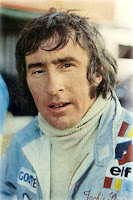


Wins: 16
Pole Positions: 16
Fast Laps: 19
Titles: 0
1. Michael Schumacher

Wins: 91
Pole Positions: 68
Fast Laps: 76
Titles: 7
2. Juan Manuel Fangio
2. Juan Manuel Fangio

Wins: 24
Pole Positions: 29
Fast Laps: 23
Titles: 5
3. Jim Clark
3. Jim Clark

Wins: 25
Pole Positions: 33
Fast Laps: 28
Titles: 2
4. Alain Prost
Pole Positions: 33
Fast Laps: 28
Titles: 2
4. Alain Prost

Wins: 51
Pole Positions: 33
Fast Laps: 41
Titles: 4
5. Ayrton Senna
Pole Positions: 33
Fast Laps: 41
Titles: 4
5. Ayrton Senna

Wins: 41
Pole Positions: 65
Fast Laps: 19
Titles: 3
6. Jackie Stewart
Pole Positions: 65
Fast Laps: 19
Titles: 3
6. Jackie Stewart

Wins: 27
Pole Positions: 17
Fast Laps: 15
Titles: 3
7. Jack Brabham
Pole Positions: 17
Fast Laps: 15
Titles: 3
7. Jack Brabham

Wins: 14
Pole Positions: 13
Fast Laps: 12
Titles: 3
8. Niki Lauda
Pole Positions: 13
Fast Laps: 12
Titles: 3
8. Niki Lauda

Wins: 25
Pole Positions: 24
Fast Laps: 24
Titles: 3
9. Graham Hill
Pole Positions: 24
Fast Laps: 24
Titles: 3
9. Graham Hill

Wins: 14
Pole Positions: 13
Fast Laps: 10
Titles: 2
10. Stirling Moss
Pole Positions: 13
Fast Laps: 10
Titles: 2
10. Stirling Moss

Wins: 16
Pole Positions: 16
Fast Laps: 19
Titles: 0
Hamilton was robbed, but Massa will win
Personally I think Hamilton was robbed of his trilling victory at Spa. He muscled the defending World Champion seemingly passing him at will in varying conditions. The fact that the stewards have interjected themselves unnecessarily will only flair up charges of FIA-Ferrari bias or claims that there is a manipulation of the championship as Hamilton was set to run away with the title. Instead of an 8 point lead for Hamilton, it has now been widdled down to 2 points with the next race on Ferrari home soil in Monza, Italy. Even though McLaren seem to have a strong case to appeal in that Hamilton gave the position back and they have provided data that Hamilton was 6 km/h slower than Raikkonen as they crossed the start/finish line, it will be for nothing and Massa will keep his win and here is why.
This incident reminds me of a lesser known circumstance from the 2005 Japanese Grand Prix in which Renault's Fernando Alonso was overtaking then Red Bull's Christian Klien. After cutting the last chicane at the Suzuka Circuit, Alonso allowed Klien back passed on the main straight, and re-passed Klien. However, it was later determined by the stewards that Alonso gained an advantage and he had to allow Klien past again. Alonso later re-passed Klien, but lost valuable time.
Here at Spa it is quite similar, just that the stakes are higher. Obviously given it was the end of the race, stewards could not order Hamilton to let Kimi through and could not issue an on-track penalty. However, the question will boil down to a simple issue. Did Hamilton gain an advantage? This is where it is a strictly judgement call and no objective position can be made. The fact that the position was relinquished should be good enough as that is what is asked for by the stewards. I do not think he gained an advantage and given that Raikkonen crashed out moments later, the issue should not even have been raised. Moreover, the fact that Massa got to keep his win at Valencia only adds fuel to the fire, as there are many that say why wasn't Massa stripped of his win?
At the end of the day, I have seen worst judgement calls. Coincidentally, at the 2006 Italian Grand Prix, Fernando Alonso was penalized for "blocking" Felipe Massa in qualifying. This call was almost criminal and again stirred up the calls that this was more FIA-Ferrari bias. Nevertheless in this case, they have precedence for penalizing Hamilton and will probably follow that precedence set at Suzuka in 2005; but hey we are talking about the FIA, and their record of making arbitrary decisions will still make waiting for a decision an interesting back story to the rest of the championship.
This incident reminds me of a lesser known circumstance from the 2005 Japanese Grand Prix in which Renault's Fernando Alonso was overtaking then Red Bull's Christian Klien. After cutting the last chicane at the Suzuka Circuit, Alonso allowed Klien back passed on the main straight, and re-passed Klien. However, it was later determined by the stewards that Alonso gained an advantage and he had to allow Klien past again. Alonso later re-passed Klien, but lost valuable time.
Here at Spa it is quite similar, just that the stakes are higher. Obviously given it was the end of the race, stewards could not order Hamilton to let Kimi through and could not issue an on-track penalty. However, the question will boil down to a simple issue. Did Hamilton gain an advantage? This is where it is a strictly judgement call and no objective position can be made. The fact that the position was relinquished should be good enough as that is what is asked for by the stewards. I do not think he gained an advantage and given that Raikkonen crashed out moments later, the issue should not even have been raised. Moreover, the fact that Massa got to keep his win at Valencia only adds fuel to the fire, as there are many that say why wasn't Massa stripped of his win?
At the end of the day, I have seen worst judgement calls. Coincidentally, at the 2006 Italian Grand Prix, Fernando Alonso was penalized for "blocking" Felipe Massa in qualifying. This call was almost criminal and again stirred up the calls that this was more FIA-Ferrari bias. Nevertheless in this case, they have precedence for penalizing Hamilton and will probably follow that precedence set at Suzuka in 2005; but hey we are talking about the FIA, and their record of making arbitrary decisions will still make waiting for a decision an interesting back story to the rest of the championship.
Sunday, September 7, 2008
Belgian Grand Prix: McLaren appeals decision
Quoted from Autosport.com
McLaren have lodged an appeal against Lewis Hamilton's demotion to third place in the Belgian Grand Prix, the FIA confirmed on Sunday night. Hamilton was handed a 25-second penalty for gaining an advantage against then race leader Kimi Raikkonen after cutting the chicane two laps from home at Spa-Francorchamps.
McLaren spent some time on Sunday night evaluating whether they could appeal the penalty, but an FIA statement said that the team had indeed notified the stewards of their intention to appeal. It means the result of the Belgian Grand Prix will now be decided at a hearing of the FIA's International Court of Appeal.
Ferrari did not hide their criticism of the way Hamilton behaved after cutting the chicane, with their team principal Stefano Domenicali saying he had no doubt the way Hamilton retook the lead was the result of the benefit he had in cutting the chicane. "Personally, I think it was a little bit extreme," he explained. "It's normal that when you attack that you are racing, but the problem is (of) the advantage that may take by doing a manoeuvre and this is the key point of it, so I think that that's the focus that has to be considered.
"What is really the advantage that you are taking in such conditions that can be used in the second situation at the first corner? That, in my view, is the most important thing. But this is racing."
Domenicali did not wish to make any comments on the decision to impose a 25-second penalty, however. "As I said to your Italian colleagues, we are not used to commenting on decisions. The only thing I would say is that as soon as we had been summoned by the stewards, we gave our position to the stewards and that was it. "Then the stewards for sure listened to the Hamilton discussion on that, and that is the decision. On that we don't want to take any further comment." Ferrari have insisted that they did not lodge any official protest with the race stewards about the matter. http://www.autosport.com/news/report.php/id/70402
We will see what is to follow...
McLaren have lodged an appeal against Lewis Hamilton's demotion to third place in the Belgian Grand Prix, the FIA confirmed on Sunday night. Hamilton was handed a 25-second penalty for gaining an advantage against then race leader Kimi Raikkonen after cutting the chicane two laps from home at Spa-Francorchamps.
McLaren spent some time on Sunday night evaluating whether they could appeal the penalty, but an FIA statement said that the team had indeed notified the stewards of their intention to appeal. It means the result of the Belgian Grand Prix will now be decided at a hearing of the FIA's International Court of Appeal.
Ferrari did not hide their criticism of the way Hamilton behaved after cutting the chicane, with their team principal Stefano Domenicali saying he had no doubt the way Hamilton retook the lead was the result of the benefit he had in cutting the chicane. "Personally, I think it was a little bit extreme," he explained. "It's normal that when you attack that you are racing, but the problem is (of) the advantage that may take by doing a manoeuvre and this is the key point of it, so I think that that's the focus that has to be considered.
"What is really the advantage that you are taking in such conditions that can be used in the second situation at the first corner? That, in my view, is the most important thing. But this is racing."
Domenicali did not wish to make any comments on the decision to impose a 25-second penalty, however. "As I said to your Italian colleagues, we are not used to commenting on decisions. The only thing I would say is that as soon as we had been summoned by the stewards, we gave our position to the stewards and that was it. "Then the stewards for sure listened to the Hamilton discussion on that, and that is the decision. On that we don't want to take any further comment." Ferrari have insisted that they did not lodge any official protest with the race stewards about the matter. http://www.autosport.com/news/report.php/id/70402
We will see what is to follow...
Belgian Grand Prix: Hamilton Stripped, Massa Wins
Lewis Hamilton has been stripped of victory at the Belgian Grand Prix after he was given a penalty for cutting a chicane when fighting with Kimi Raikkonen in the closing laps. The stewards gave Hamilton a drive-through penalty after the race, which means 25 seconds were added to his time.
The win goes to Ferrari's Felipe Massa, who was running and finished 2nd. Due to the time penalty incurred by Hamilton, he is now officially classified as 3rd in the race results. An additional note, Toyota's Timo Glock was also penalized 25 seconds and finished 9th instead of 8th which gave Red Bull's Mark Webber valuable points.
The stewards just made the title fight a bit closer. Instead of an 8 point lead for Hamilton, Massa has cut the Hamilton's lead to just 2 points. A great drive has gone unrewarded. Below is the revised classification.
1. Massa
2. Heidfeld
3. Hamilton
4. Alonso
5. Vettel
6. Kubica
7. Bourdais
8. Webber
9. Glock
10. Kovalainen
11. Coulthard
12. Rosberg
13. Sutil
14. Nakajima
15. Button
16. Trulli
17. Fisichella
18. Raikkonen
The win goes to Ferrari's Felipe Massa, who was running and finished 2nd. Due to the time penalty incurred by Hamilton, he is now officially classified as 3rd in the race results. An additional note, Toyota's Timo Glock was also penalized 25 seconds and finished 9th instead of 8th which gave Red Bull's Mark Webber valuable points.
The stewards just made the title fight a bit closer. Instead of an 8 point lead for Hamilton, Massa has cut the Hamilton's lead to just 2 points. A great drive has gone unrewarded. Below is the revised classification.
1. Massa
2. Heidfeld
3. Hamilton
4. Alonso
5. Vettel
6. Kubica
7. Bourdais
8. Webber
9. Glock
10. Kovalainen
11. Coulthard
12. Rosberg
13. Sutil
14. Nakajima
15. Button
16. Trulli
17. Fisichella
18. Raikkonen
Belgian Grand Prix: Hamilton Wins like a Champ
 McLaren-Mercedes driver, Lewis Hamilton won a dramatic and chaotic Belgian Grand Prix in fine, dare I say, World Championship fashion. He demonstrated his driving ability as well as his grit, determination and downright competitive spirit. He has good fortune on his side, but the skill and poise demonstrated today will make Hamilton a legend in the sport. All of this praise for Hamilton comes at the expense of Ferrari's Kimi Raikkonen who was out muscled by Hamilton but still had an opportunity to close the deal. Alas, he threw the race away in the final laps as rain hit the track and he crashed out. Early season powerhouse BMW-Sauber has fallen on hard times with their performance, but have stolen a podium place with driver Nick Heidfeld after making a shrewd call with the tires at the end of the race and claiming 3rd.
Hamilton extends his points lead over Ferrari's Felipe Massa to 8 points and defending World Champion Kimi Raikkonen might have thrown away his chance to defend his title as he is overtaken in the standings by BMW-Sauber driver Robert Kubica. Raikkonen is now 23 points behind World Championship leader Hamilton.
In regards to this weekend's Points of Interest:
1. Williams. Rosberg confirms his speed advantage over Nakajima who struggled with pace and grip. Williams appears to have the advantage over Honda now. Perhaps this is confirming that Honda has now completely set its sights on the 2009 season. Red Bull is still superior to Williams, but they seem to be lacking in performance in relation to Williams and the Red Bull junior team, Toro Rosso.
2. Toro Rosso. They have confirmed that their package is for real. Bourdais and Vettel put in very solid drives and Bourdais nearly stole his own podium position at the end of race, but the staying out of dry tires hurt him. The chassis is good and Ferrari power has given them an edge that should help them in the final races of the season, as now they are in a position to challenge for 6th in the Constructor's Title. If they can manage the feat, they would beat Honda, Williams and Red Bull Racing; a great accomplishment. They are firmly a mid-field team now and not a tail-end team.
3. Speed differential. It is was very similarly dispersed as it was in qualifying. Ferrari and McLaren have a power advantage as well as superior aerodynamics. BMW has power, but one wonders about their aerodynamic efficiency. Renault have a good chassis, but questions about their power is keeping them from regular podiums.
A performance worth noting is that of Renault's Fernando Alonso. He has demonstrated his abilities as a team leader and his abilities as a car developer. Perhaps the recent Monza tests proved to be a gold mine of knowledge and learning the combination of tires and chassis. His performance at Spa is indicative of the talent behind the wheel matched with racecraft that is second to none. I firmly believe that Alonso will be at Renault next season.
1. Hamilton
2. Massa
3. Heidfeld
4. Alonso
5. Vettel
6. Kubica
7. Bourdais
8. Glock
9. Webber
10. Kovalainen
11. Coulthard
12. Rosberg
13. Sutil
14. Nakajima
15. Button
16. Trulli
17. Fisichella
18. Raikkonen
Fastest lap: Raikkonen, 1:47.930
Saturday, September 6, 2008
Belgian Grand Prix: Points of Interest/Qualifying
McLaren-Mercedes driver Lewis Hamilton gets pole position for Sunday's Belgian Grand Prix. As it relates to the my Points of Interest for the Belgian Grand Prix, this is how its shaping up.
1. The performance of Williams. So far the battle of speed is as expected with Rosberg going quicker than Nakajima. However, it was a surprise to see Nakajima struggle so much in qualifying. As it relates to Williams vs. Red Bull and Honda in qualifying, Webber has been able to show his speed in relation to Coulthard and that the Red Bull chassis is very strong. Williams the last several years have not been able to keep the development pace of the other teams and the performance as the season progresses shows it. However, I was expecting at least one Williams perform better. Nonetheless, it is interesting to see Rosberg in the Williams outqualify both Hondas.
2. Toro Rosso. Watching the performance of Sebastien Bourdais was awesome. He put in very good laps in Q1 (setting the best time!) and Q2. Again, being that Toro Rosso chassis is essentially the Red Bull chassis, it is only confirming the strength of the design and development the car has undergone, not to mention the power Ferrari engine which I think the Red Bull team would love to have. Ferrari power is strongly represented in the speed traps in all 3 sectors, particularly in sector 1 via the Ferrari factory team and the 2 customer teams, Toro Rosso and Force India.
3. Speed differential. The speed differential across all sectors is not as pronounced as I expected, but we still have the race to run. However, in the fastest part of the track (sector 1), Ferrari seem to have a distinct advantage which again would indicate more power available. The representation of other teams in different sectors can also be a function of aerodynamic set up and efficiency. For example, Renault is strongly represented in the speed traps for sector 2 and 3 but down in sector 1. Given Alonso's qualifying performance, the chassis is working well and they are probably carrying more downforce on the car but it is hurting them in the faster sections, like sector 1.
We will continue to see how these points of interest develop now as we go into the race on Sunday.
1. The performance of Williams. So far the battle of speed is as expected with Rosberg going quicker than Nakajima. However, it was a surprise to see Nakajima struggle so much in qualifying. As it relates to Williams vs. Red Bull and Honda in qualifying, Webber has been able to show his speed in relation to Coulthard and that the Red Bull chassis is very strong. Williams the last several years have not been able to keep the development pace of the other teams and the performance as the season progresses shows it. However, I was expecting at least one Williams perform better. Nonetheless, it is interesting to see Rosberg in the Williams outqualify both Hondas.
2. Toro Rosso. Watching the performance of Sebastien Bourdais was awesome. He put in very good laps in Q1 (setting the best time!) and Q2. Again, being that Toro Rosso chassis is essentially the Red Bull chassis, it is only confirming the strength of the design and development the car has undergone, not to mention the power Ferrari engine which I think the Red Bull team would love to have. Ferrari power is strongly represented in the speed traps in all 3 sectors, particularly in sector 1 via the Ferrari factory team and the 2 customer teams, Toro Rosso and Force India.
3. Speed differential. The speed differential across all sectors is not as pronounced as I expected, but we still have the race to run. However, in the fastest part of the track (sector 1), Ferrari seem to have a distinct advantage which again would indicate more power available. The representation of other teams in different sectors can also be a function of aerodynamic set up and efficiency. For example, Renault is strongly represented in the speed traps for sector 2 and 3 but down in sector 1. Given Alonso's qualifying performance, the chassis is working well and they are probably carrying more downforce on the car but it is hurting them in the faster sections, like sector 1.
We will continue to see how these points of interest develop now as we go into the race on Sunday.
Friday, September 5, 2008
Massa and Alonso lead Friday practice sessions
Quoted and edited from Autosport.com:
Felipe Massa maintained his recent strong form by dominating Friday morning practice for the Belgian Grand Prix. Massa was fastest for the majority of the morning at an overcast but dry Spa-Francorchamps, setting the first flying lap of the weekend and then repeatedly improving his time as his first run progressed. Massa also switch to soft tyres for his final run and found even more time, improving to first a 1:47.369 then 1:47.284 to cement his position as the opening practice pace-setter.
Fernando Alonso grabbed the top spot at the end of a rain and red flag-interrupted Friday afternoon practice session at Spa with a 1:48.454 sec. lap. Several drivers went off track during the session, Alonso, Raikkonen Webber, Fisichella all had moments of difficulty with track conditions.
http://www.autosport.com/news/report.php/id/70287
http://www.autosport.com/news/report.php/id/70294
Felipe Massa maintained his recent strong form by dominating Friday morning practice for the Belgian Grand Prix. Massa was fastest for the majority of the morning at an overcast but dry Spa-Francorchamps, setting the first flying lap of the weekend and then repeatedly improving his time as his first run progressed. Massa also switch to soft tyres for his final run and found even more time, improving to first a 1:47.369 then 1:47.284 to cement his position as the opening practice pace-setter.
Fernando Alonso grabbed the top spot at the end of a rain and red flag-interrupted Friday afternoon practice session at Spa with a 1:48.454 sec. lap. Several drivers went off track during the session, Alonso, Raikkonen Webber, Fisichella all had moments of difficulty with track conditions.
http://www.autosport.com/news/report.php/id/70287
http://www.autosport.com/news/report.php/id/70294
Thursday, September 4, 2008
Wet Weather Driving is Overrated
Back in 2007, I looked into wet weather driving and its importance in the overall scheme of Formula One racing from the years 1977-2006. I wanted to see if it was important to possess such skill to be a success F1 driver. For example, Alain Prost was not considered to be a very good wet weather driver, but he won 4 championships and retired the all time leader in F1 wins. Currently, Felipe Massa appears to be useless in the wet, but is right in the thick of the championship battle against Hamilton and Raikkonen; drivers that are superior to him in wet conditions. I am revisiting this data in the season and a half since it was collected. For the sake of disclosure and reader fact checking, the numbers were calculated using FORIX and show the number of F1 races that had official weather conditions of either rain, wet or showers (no qualifying sessions were calculated).
The question boils down to "what is the actual advantage when 87% of the races from 1977-2006 were dry races?" In this period there have been 11 seasons where the title was decided by 8 points or less; only 4 of them are seasons in which the driver that scored the most points in wet races won a title. Those seasons are 1983, 1988, 1990 and 1999. In the 2007, we had 3 wet races and the title was decided by 1 point. The driver that scored the most points in wet conditions was Fernando Alonso and he technically finished 3rd in the title chase behind Hamilton and Raikkonen, drivers that have also demonstrated to be quick in wet conditions. However, if a rain master like Alonso can score the most points in rain conditions but lose the title, what difference does it make?
Given the data that was accumulated, wet weather driving ability is not so important. It is not important to the same degree that a single driver's car development skills are not important. If 87% of races in the past 30 years are dry races than the likelihood of using such skills is remote; in the same way that if a driver with poor car development skills is supported by good testers and a teammate that possesses such skills or there is a rules package that deminishes the value of such skills, the hinderance is minimized. In both wet weather driving and car development, the 'weakness' is hidden. In the first case, by the lack of wet weather. In the second case, by the skills of teammates or rules package. In my opinion you can be an average driver in the wet, maybe even below average, like Massa, and still be a successful driver.
There will be moments in time and history where these skills will be the difference. The period of 1987-1996, nearly 17% of the races were wet races (more than the average) is a period for driver like Senna to shine. In 2007, wet weather driving skills, or lack thereof, continued to not have an impact. However in 2008, we will see if it plays role. The 2 wet races this season have been won by Lewis Hamilton. He has a 6 point lead over Felipe Massa; again a driver that many consider to be below average in wet conditions. If Massa wins the title, it would continue to confirm that wet weather driving skills are fun to watch but not important to being a World Champion.

The question boils down to "what is the actual advantage when 87% of the races from 1977-2006 were dry races?" In this period there have been 11 seasons where the title was decided by 8 points or less; only 4 of them are seasons in which the driver that scored the most points in wet races won a title. Those seasons are 1983, 1988, 1990 and 1999. In the 2007, we had 3 wet races and the title was decided by 1 point. The driver that scored the most points in wet conditions was Fernando Alonso and he technically finished 3rd in the title chase behind Hamilton and Raikkonen, drivers that have also demonstrated to be quick in wet conditions. However, if a rain master like Alonso can score the most points in rain conditions but lose the title, what difference does it make?
Given the data that was accumulated, wet weather driving ability is not so important. It is not important to the same degree that a single driver's car development skills are not important. If 87% of races in the past 30 years are dry races than the likelihood of using such skills is remote; in the same way that if a driver with poor car development skills is supported by good testers and a teammate that possesses such skills or there is a rules package that deminishes the value of such skills, the hinderance is minimized. In both wet weather driving and car development, the 'weakness' is hidden. In the first case, by the lack of wet weather. In the second case, by the skills of teammates or rules package. In my opinion you can be an average driver in the wet, maybe even below average, like Massa, and still be a successful driver.
There will be moments in time and history where these skills will be the difference. The period of 1987-1996, nearly 17% of the races were wet races (more than the average) is a period for driver like Senna to shine. In 2007, wet weather driving skills, or lack thereof, continued to not have an impact. However in 2008, we will see if it plays role. The 2 wet races this season have been won by Lewis Hamilton. He has a 6 point lead over Felipe Massa; again a driver that many consider to be below average in wet conditions. If Massa wins the title, it would continue to confirm that wet weather driving skills are fun to watch but not important to being a World Champion.
Data using FORIX: 1977-2006

Subscribe to:
Posts (Atom)