Showing posts with label History/Nostalgia. Show all posts

Wednesday, September 28, 2011

The Risk of Innovation

Tyrrell 019, photo by Sibo
F1 has a lot of nuance to it whether you are talking strategies, driving styles, off track politics, or technical development; and that technical development is mind blowing ; it is an arms race for gaining time. More and more the technical side of F1 has been about aerodynamics. Teams spend vast sums of money to improve car performance in this area. Even items that are not logically geared towards the aerodynamic performance, are in fact geared towards the aerodynamic performance of the car.

Since work on other components like engine development have virtually been eliminated, aerodynamic performance is the be all-end all of F1 performance. Hence, a very large factor in Red Bull's current dominance has been their iconoclast designer and renown  aerodynamist, Adrian Newey.  With engine development frozen, DRS and KERS still in their infancy, spec tires, you have to have top notch aero. This chase has lead to some teams to some interesting concepts, some successful, others not so successful. However, it is the price of looking to be innovative and chase those ever elusive tenths of seconds. We have seen these innovations take root, or be banned from competition or just flop.

Innovation can pay off or it can cost you. When we think of the most recent noteworthy technical innovation, the exhaust blown diffuser, it is not widely talked about that this innovation was pioneered in 1983 by Renault and Jean Claude Migeot. It became the standard in F1, then fell out of favor completely a decade ago with the advent and development of periscope exhausts, before being revived by Adrian Newey in an effort to maximize the downforce generated under the car; the place where most downforce is generated. A huge payoff for Red Bull.  

Then there is the story of Tyrrell (the genesis of the current Mercedes team), a championship winning team with a history of innovation. Tyrrell is probably most remembered for their 6-wheeled F1 car, the P34. However, they had several innovations that have carried over to contemporary F1. Generally speaking, they were all aimed at aerodynamic performance because they were lacking in the areas where the bigger teams dominated: engines and horsepower.

Tyrrell 025, photo by Rainer Nyberg
Before the days of engine freezes and standard engine designs you could overcome some aerodynamic deficiencies via horsepower, and you could be rather competitive this way. However if you did not have a good engine, you had to look towards other avenues to increase your performance...i.e. aerodynamics. In 1990, Tyrell and legendary Harvey Postlethwaite (whom Newey worked for) and Jean Claude Migeot introduce the world of F1 to raised noses, a concept that has been the standard design to varying degrees since 1996. Some of the other innovations from Tyrrell: aerodynamically shaped wishbones (again the concept is standard) in 1996. the notoriously ugly yet effective X wings in 1997 (banned by the FIA in 1998). The payoff was for other teams following the innovations. The Tyrrell name disappeared from F1 after they were purchased by British American Tobacco.

Williams FW26, photo by BMW AG
In 2004, Williams introduced a walrus-nose shaped F1 car, the FW26. This was a different and radical take on the raise nosed concept. The car was an acquired taste visually, but the aim was the same: achieve more airflow to the underside of the car to gain that aerodynamic advantage. However, Williams had what teams like Tyrell did not have, one of the best engines of the V10 era, the P84. Williams and driver Juan Pablo Montoya were favorites for the title. However, the design turned out to be a flop. The concept proved to be more heavy then anticipated, which led to instability and to car setup issues. They went with a more conventional design later in the 2004 which culminated in the team's sole victory at the end of the season. Williams took a risk with a innovative design after nearing winning the driver's championship with Montoya in 2003 and they failed. Williams have never been the same since. 

In late 2005, Renault introduced the Tuned Mass Damper (TMD), a movable weight in the car that helped the car perform better over bumps and keep a consistent contact with the track, improving grip and aerodynamic performance. The development of this technology helped them secure the 2005 title as well as being an important component to their 2006 championship winning car the R26.  This technology was banned in controversial fashion in 2006. However it's performance was subsequently replicated by the J damper, a standard arrangement in F1 introduced by McLaren.  

In 2010, McLaren introduced the "F-Duct" on their MP4-25. The design used a small snorkel mounted in front of the driver that channeled air through a duct in the cockpit and towards the rear wing. Changes in the pressure in the duct reduced the aerodynamic drag of the wing allowing for an extra 6 mph on a straight away, a poor man's but very ingenious DRS.  Although a legal component, it was banned for 2011. McLaren had a very competitive package but could not capitalize to a win the title. 

Now to go full circle with exhaust blown diffusers. In 2011, Renault introduced a radical front exit exhaust (FFE) on their R31. Instead of a "traditional" periscope or exiting into the diffuser, the exhaust exited below the sidepod inlets. The aim was to blow exhaust gases under the floor and around the sidepods.Where Red Bull got it right, Renault admits they go it wrong. They admit they could not really develop it as the season progressed and it was too complicated for them to consistently generate downforce at all the tracks. Renault even experimented with going to a more traditional layout (like Williams in 2004) but they could not make that work either. After a very promising 2010 season, they put a lot of effort in 2011 and came up snake eyes from a design point of view. 

Nevertheless all of this gets us to the point. Sometimes you get it right and it changes the way the sport operates and moves it forward. Sometimes you innovations get banned because it is too clever or just plain illegal. Sometimes you just get it wrong and you have a terrible and useless design. However, in it's purist form, isn't that what innovation is all about; taking risks, trying to be quicker, advance the technology? I much rather see teams try something innovative and bump up against the rules or truly make an technological advancement than the push towards standardization.   


Sunday, September 18, 2011

Nostalgia: Jackie Stewart

A true motorsports icon, 3 times F1 World Champion (1969, 1971, 1973), retired having the most grand prix victories,  a pioneering advocate for racing safety and a legend that survived his era to make it to the other side. Even if you never saw him race, you are sure to know his voice and his post racing career activities as a racing commentator, TV show host and team owner. 

Just as follow Scotsman Jim Clark, Stewart's name is scattered through the record books. His win percentage is better than both Alain Prost and Ayrton Senna. He is one of the most smoothest and effortless drivers in the history of F1. His ability to convey the complex subject of motor racing into a very detailed, clear, yet simple analogy is unmatched.  

Here are a few Jackie Stewart videos including a musical tribute, Jackie demonstrating his teaching ability, Jackie on safety and Jackie in one of his finest drives. Enjoy:

Jackie Stewart Tribute Video


Sunday, September 4, 2011

Nostalgia: Jim Clark, One of the Best if not The Best

Image LAT Photographic
There are many drivers that F1 observers think are great, but there are few in which there is near universal agreement on, Juan Manuel Fangio, Ayrton Senna and Jim Clark. Driving in an era where death was common place Clark demonstrated his utter worldly speed and natural ability to drive all things mechanical; Indycars, NASCAR, Sportscars, Rallying, farm tractors (okay, not really but he would have). He boasts 2 World Championships (1963, 1965) and one of the highest win percentages in history (.342) only outdone by Fangio and the great Alberto Ascari. You will still find his name near the top of other F1 records: wins, win % in a season, consecutive wins, pole positions, pole position %, front row start %, fast laps, consecutive podium finishes, most lap led, pole-win-fast lap in the same race, and you get the picture.

Tragically and common of the era, Clark was killed in a F2 race at Hockenheim in 1968. He was 32 and easily still in his prime. In his last F1 race, he took the pole, set the fastest lap and won the race; a feat he achieved 11 times and only bettered by Michael Schumacher. He participated in 73 grand prix which by contemporary F1 standards would be a little more than 4 seasons. So, when you think about his statistical achievements and factor in his passing, and the lack of safety in this era, it is truly staggering. Of course, stats are not even the half of it. There is the famous quote of fellow racer, Chris Amon, "If this can happen to Jimmy, what chance do the rest of us have?" which speaks to the magnitude of the respect and level of his skill in an era with drivers like Graham Hill, Jackie Stewart, Jack Brabham, and Dan Gurney.

Clark had many great drives. I have uploaded a few videos of the grand prix legend; some of which are considered some of his very best performances in a race car. 


Thursday, September 1, 2011

Remembering September 2001

As we get close to the 10th anniversary of the September 11th attacks on the United States, there is a lot to say and think about; what is remembered, what is forgotten, what has changed, the sorrow, the anger, the pride. Since this is a space dedicated to F1 and motorsports, I will only share some of my thoughts as each of us has their own personal experience with the event American or not. There were many in F1 that took it on the chin. A number of sponsors had offices at the World Trade Center, Michael Schumacher seriously contemplated retirement and  drivers considered not racing. However, there were numerous acts of solidarity with the United States from F1.  

I recall watching the two grand prix that were held that month, the Italian Grand Prix at Monza and the United States Grand Prix at the Indianapolis Motor Speedway. I fortunately did not lose any loved ones on that day, but it was a period of time that can only be described as a melancholic fog; a collection of incoherent mental images that left me feeling like I received a couple of knockout punches. Another kick in the teeth was the fact that two of the hijacked aircraft came out of out my hometown of Boston, MA.

As far as the racing went, there were three things I can distinctly recall about that race weekend. One, the Italian GP was already under a pall as the 2000 race was marred by the death of fire marshal, Paolo Ghislimberti. Two, I was preparing to get news that then CART racer and ex-F1 driver Alex Zanardi was going to die after losing both his legs in a horrible crash in Germany. Three, remembering then Williams driver Juan Pablo Montoya winning the race and thinking what a shitty race and time to get your first F1 win. Thankfully, Zanardi survived his accident and to this day proves to be an enduring testament to the power of human will. As it relates to the USGP, I honestly could not tell you who one the race without having to look it up. I was a bit more caught up in the acts of solidarity.  An interesting bit of numerology is that 10 years after those tragic events, this year's Italian Grand Prix will be on September 11th. I wonder if there will be remembrances given the very classy way Ferrari acted.

Below you will find a collection of some quotes and news story excerpts in the F1 community in regards to those events:
"In mid August, having won our third consecutive Constructors' Championship, we decided to meet the international Formula One press. At the time, we could not have predicted the events of yesterday. I was at the Frankfurt Motor Show and was deeply affected. Personally, I feel very close to the USA, as I was at university in New York. I admire the democracy in the USA." Luca di Montezemolo, Atlas F1 News Service, 9/12/01

"The Jaguar Racing team may withdraw from the Italian Grand Prix this weekend following the terrorist attacks in the United States on Tuesday. 'We are reviewing the situation all the time,' a Jaguar spokesperson was quoted as saying by The Times. 'We want to do what is best.' ...Two of Jaguar's main sponsors, HSBC and AT&T, had offices within the World Trade Center, which collapsed after two planes crashed into both towers." Jaguar Considering Pulling Out of Italian GP, Atlas F1 New Service, 9/13/01

"It's pretty difficult to find the right expression for what has happened there and what we feel. I think in all of us it is pretty much the same... the sympathy is naturally all with them and the support as much as we can support. It's going to be a tough time." Michael Schumacher, 9/13/01

"Grand Prix racing is to observe a European-wide three-minute silence on Friday to honor the thousands who died in the terrorist attacks on New York and Washington earlier this week. The sport is joining in the European Union's designated official period of silence. The morning's free practice session is to start early and end early to allow the silence to be observed at midday local time. F1 team bosses have also decided that no engines will be run for 10 minutes."  F1 to pay its respects in Monza, Autosport.com, 9/13/01

"It (USGP for 9/30) should go ahead, I believe it. What happened there is crazy, absolutely mental but I think the worse thing they could do is to try to stop the country...if they do that it would be more joy to whoever did it. It is a tough thing but they should try to keep going and it could help take the mind off (things) for a lot of people." Juan Pablo Montoya, Atlas F1 News Service, 9/13/01

"The Ferrari team have announced their decision to run their cars without any logos from their sponsors and suppliers as a mark of respect to the American people following Tuesday's terrorist attacks in New York and Washington." Ferrari Strip Cars of Advertising for Monza, Atlas F1 News Service, 9/13/01

"Daimler-Chrysler, parent of team partners Mercedes, have started a $10 million fund and McLaren said they would donate heavily. 'There is extensive communication through to all the members of the organization throughout the world and many of them are already pledging either personal income or funding,' said McLaren team boss Ron Dennis at the Italian Grand Prix. 'That will be supplemented by the TAG McLaren Group. There are going to be a lot of kids without parents...The aftermath of this is going to be very much felt by young people.' " Alan Baldwin, F1 Mourns Terror Victims, Atlas F1 News Service, 9/14/01

"I think it is the whole world's tragedy. We have to look at what is happening and the feeling in the paddock is not the best. No one is happy. Normally F1 is a celebration but there's nothing to celebrate here when we see what is happening around the world. There is stress, everybody is concerned and the first thing you do when you wake up in the morning is to turn the television on to see if there is any news. We still have to carry on, we have to take care of what is happening but we can't stop otherwise the people that attacked the USA will have won their battle and we cannot let this happen." Jarno Trulli, 9/14/01

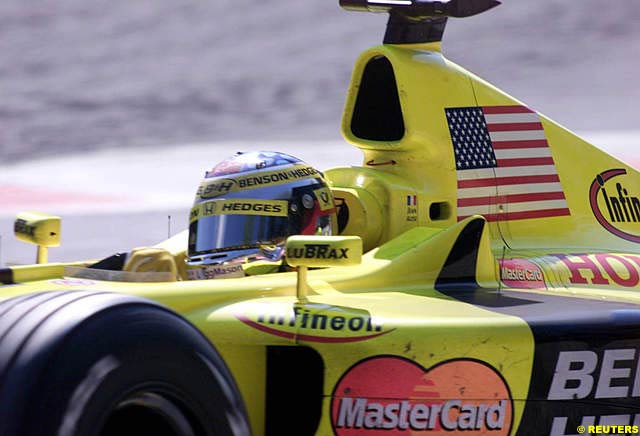
"A variety of tributes were paid to those killed in the terrorism attacks on New York and Washington during Friday's opening free practice session for the United States Grand Prix. Jaguar Racing, who have large backing from America, led the marks of respect as they donned black nose cones similar to the one used by Ferrari at Monza two weeks ago. Ferrari reverted back to their all-red car at Indianapolis, but sported an American flag on the side of Michael Schumacher and Rubens Barrichello's cars. Jordan also ran with the Stars and Stripes emblem on their EJ11, while driver Jarno Trulli's helmet included a statement which read: "God Bless America"." Teams Pay Tributes to US Causalities in Free Practice, Atlas F1 News Service, 9/28/01

Sport is a curious thing. In a lot of cases it can divide. The opposition is the enemy to be hated and reviled. Yet, it can bring people together like nothing else. You have the shared knowledge that where ever your allegiances lay, there is the common denominator of having the passion and interest of that sport. We experience or witness this in our everyday lives whether we are talking about different countries, races or religions/spirituality. Then there are moments when the world "stops" and everyone takes in the idea that there are common denominators to be celebrated and there are things that are bigger than squabbling over the differences.