This weekend's Brazilian Grand Prix is the season finale for what has been a spirited and competitive season. Below are this weekend's points of interest:
1. Hamilton v. Massa. This is the showdown everyone is here to see. Although Hamilton only needs a 5th place to win the championship, the old saying "to finish first, you first must finish" is still applicable. McLaren F1 CEO Martin Whitmarsh has publicly admitted to fears about McLaren reliability given the gearbox problem that Hamilton had last year. With Massa being a race winner here and with all the motivation in the world he is a race favorite. He will need to win to maximize his title chances.
2. Kubica v. Raikkonen. Robert Kubica sits 3rd in the championship standings however is still under threat from Kimi Raikkonen who is only 6 points behind. Kubica can not coast in this race with Renault's pace as they would take points from him. For Raikkonen, finishing 3rd in the title fight would salvage what has been a very disappointing title defense year.
3. Wet Weather. Looking at the forecast, rain can play a factor in the title fight. Massa is not very good in the wet and Hamilton has shown to a be rain master. However, we have seen the best wet weather drivers throw their cars off the road. So by all means, there are guarantees that if it rains Hamilton's a lock for the title.
Enjoy the Grand Prix!
Friday, October 31, 2008
Tuesday, October 28, 2008
Ferrari & Toyota strike back against standardization
Yesterday there were some bombs tossed in the direction of the FIA with Ferrari and Toyota making threats that they would quit Formula One if the standard engine proposal laid out last week by Max Mosley and the FIA goes through as planned.
There has been speculation that Toyota would forgo F1 in favor of running at LeMans and presumably in a sportscar series ala American LeMans Series or the European based Endurance LeMans Series where the technical rules are far less restrictive if the plan goes through.
Also, after Ferrari president Luca di Montezemolo backed radical calls for cost reduction (as did Toyota chief John Howett) Ferrari drew their line in the sand that they might pull out of F1 altogether if the standardization plan continues. "Whilst reiterating its wholehearted commitment to a substantial and needed reduction in costs in Formula One, starting with propulsion, the Ferrari Board of Directors expressed strong concerns regarding plans to standardize engines as it felt that such a move would detract from the entire reason of a sport with which Ferrari has been involved continuously since 1950, a raison d'etre based principally on competition and technological development. The Board of Directors expressed the opinion that should these key elements be diminished, it would have to re-evaluate, with its partners the viability of continuing its presence in the sport."
As John Howett has professed to autosport.com, "I think you will see manufacturers potentially leaving F1 if there is a standard engine. I don't think any of the manufacturers want a homogenized engine."
Given that Honda is the largest manufacturer of internal combustion engines probably means they will be next to make a threat.
I had feared that the FOTA was laying down at the feet of Mosley in the name of cost reduction. Although they like cost reduction as it will improve the bottom line, I am bolstered by the notion that the manufacturers are looking to strike a balance of cost reduction and preserving the very reason why they are in Formula One...advertise their brand and technological capabilities. All of the manufacturers in Formula One already participate, in one form or another, a standardized series. The question is, even with the cost reductions already set to come on line, will Mosley back down from the standard engines given the manufacturers threats.
There has been speculation that Toyota would forgo F1 in favor of running at LeMans and presumably in a sportscar series ala American LeMans Series or the European based Endurance LeMans Series where the technical rules are far less restrictive if the plan goes through.
Also, after Ferrari president Luca di Montezemolo backed radical calls for cost reduction (as did Toyota chief John Howett) Ferrari drew their line in the sand that they might pull out of F1 altogether if the standardization plan continues. "Whilst reiterating its wholehearted commitment to a substantial and needed reduction in costs in Formula One, starting with propulsion, the Ferrari Board of Directors expressed strong concerns regarding plans to standardize engines as it felt that such a move would detract from the entire reason of a sport with which Ferrari has been involved continuously since 1950, a raison d'etre based principally on competition and technological development. The Board of Directors expressed the opinion that should these key elements be diminished, it would have to re-evaluate, with its partners the viability of continuing its presence in the sport."
As John Howett has professed to autosport.com, "I think you will see manufacturers potentially leaving F1 if there is a standard engine. I don't think any of the manufacturers want a homogenized engine."
Given that Honda is the largest manufacturer of internal combustion engines probably means they will be next to make a threat.
I had feared that the FOTA was laying down at the feet of Mosley in the name of cost reduction. Although they like cost reduction as it will improve the bottom line, I am bolstered by the notion that the manufacturers are looking to strike a balance of cost reduction and preserving the very reason why they are in Formula One...advertise their brand and technological capabilities. All of the manufacturers in Formula One already participate, in one form or another, a standardized series. The question is, even with the cost reductions already set to come on line, will Mosley back down from the standard engines given the manufacturers threats.
Tuesday, October 21, 2008
Historic and fundamental change in F1
In what is being described as historic changes to Formula One, the FIA and the Formula One Teams' Association (FOTA) have announced sweeping changes in the name in cost reduction. It is understood that this radical agreement was reached between FIA president Max Mosley and FOTA leaders Luca di Montezemolo and John Howett to introduce dramatic cost reductions starting in 2009. There are additional cuts in the works for 2010 and beyond.
According to autosport.com some of the changes are:
- Engine life will be increased from two to three races from 2009.
- Manufacturers must be prepared to make 25 engine units available, at a cost of 10 million Euros, to customer teams.
- There will be a further meeting between FOTA members in Brazil to determine testing kilometre limits for 2009, and an agreement in principal on the introduction of a standard Kinetic Energy Recovery System (KERS) unit for 2010 or 2011. KERS is believed to remain open for teams to use next season.
- The sport's governing body and FOTA will meet again after the Brazilian Grand Prix to discuss measures to reduce costs related to chassis development and the continuation of the use of customer chassis in the future.
In an letter penned to the FOTA by Max Mosley yesterday, Mosley laid out the financial concerns and asked for teams' input to help make the sport sustainable. Moreover, he laid out the FIA vision of the future in which he discussed standard engines, custom and customer gearboxes, standard components of the chassis, and solicitated suggestions regarding race procedures or "the show".
It would appear that Max Mosley has cunningly struck at the moment when teams and manufacturers were most vulnerable (losing money in an economic downturn) to essentially bring Formula One back to the 1970's or to some "the Golden Era"; something Mosley made no secret of over the years. With the specifics of the radical changes to come out shortly, F1 will enter a new, old era racing. Honestly, I am not sure where this puts Formula One. On the surface, I would simply say these agreements just makes them a global open wheel NASCAR series. I am sure if F1 fans wanted NASCAR or a complete standardization of the series, they would have just watched NASCAR or the Indy Racing League (IRL). Given what fan surveys called for, I do not see this move as keeping Formula One fans interested. However, fans are a fickle bunch and it just might be the solution in making F1 more popular. I just as you, will be watching what the specifics will be.
Nevertheless, feel free to check out opinions and information on the financial crisis that led to today's announcement:
http://formulaoneamerica.blogspot.com/search/label/Business%2FTech
According to autosport.com some of the changes are:
- Engine life will be increased from two to three races from 2009.
- Manufacturers must be prepared to make 25 engine units available, at a cost of 10 million Euros, to customer teams.
- There will be a further meeting between FOTA members in Brazil to determine testing kilometre limits for 2009, and an agreement in principal on the introduction of a standard Kinetic Energy Recovery System (KERS) unit for 2010 or 2011. KERS is believed to remain open for teams to use next season.
- The sport's governing body and FOTA will meet again after the Brazilian Grand Prix to discuss measures to reduce costs related to chassis development and the continuation of the use of customer chassis in the future.
In an letter penned to the FOTA by Max Mosley yesterday, Mosley laid out the financial concerns and asked for teams' input to help make the sport sustainable. Moreover, he laid out the FIA vision of the future in which he discussed standard engines, custom and customer gearboxes, standard components of the chassis, and solicitated suggestions regarding race procedures or "the show".
It would appear that Max Mosley has cunningly struck at the moment when teams and manufacturers were most vulnerable (losing money in an economic downturn) to essentially bring Formula One back to the 1970's or to some "the Golden Era"; something Mosley made no secret of over the years. With the specifics of the radical changes to come out shortly, F1 will enter a new, old era racing. Honestly, I am not sure where this puts Formula One. On the surface, I would simply say these agreements just makes them a global open wheel NASCAR series. I am sure if F1 fans wanted NASCAR or a complete standardization of the series, they would have just watched NASCAR or the Indy Racing League (IRL). Given what fan surveys called for, I do not see this move as keeping Formula One fans interested. However, fans are a fickle bunch and it just might be the solution in making F1 more popular. I just as you, will be watching what the specifics will be.
Nevertheless, feel free to check out opinions and information on the financial crisis that led to today's announcement:
http://formulaoneamerica.blogspot.com/search/label/Business%2FTech
Sunday, October 19, 2008
Chinese Grand Prix: Hamilton walks it
Lewis Hamilton took victory in the Chinese Grand Prix and made it look easy from start to finish. Hamilton put last weekend's Japanese Grand Prix behind him and silenced some of his critics for the moment; as he did not put away Felipe Massa. Massa finished 2nd after he simply was outpaced by Hamilton and a resurgent Kimi Raikkonen who let Massa by with the "non-team orders" orders as the race was in it's final stages. Nevertheless, Ferrari was no match for Hamilton and conceded that Hamilton was in a different league today. In addition to establishing a 7 point lead going into the final race of the season in Brazil, he exercised the demons that was last year's Chinese Grand Prix. Although his aggressive style can cost him at times, he is still developing as a driver and his racecraft will continue to improve with time. The possibilities seem scary. At the moment, he does not look flustered and he and the team are calm. They look poised to lock up the title in Brazil.
In terms of points of interest:
1. Alonso and Renault. Alonso and Nelson Piquet both scored points today. Given the pace of Hamilton, Alonso had no chance to win and conceded that 4th place was the best possible result and they achieved that result. As predicted Nelson Piquet's starting slot was not going to hinder him in terms of getting some points. He is looking more comfortable and his recent performances may have gone a long way to help him keep his job.
2. Kubica. He did a fine job coming up through the field to finish 6th after a mess of a qualifying that him locked in to a not so ideal car set-up. The car got better as they got deeper into the race and after changing to the soft compound tires he got the performance he needed. He lost his shot to extend the title fight to Brazil, however he still needs to fend off a surging Kimi Raikkonen if he is to keep 3rd place in the World Championship. A wonderful achievement for Kubica if he can do it.
3. Kovalainen. He was running in the points in the non-descript way that has been the definition of his season. He has been outpaced by many of the front runners this season and has suffered from some back luck. Today's race was simply another example of Kovalainen's quiet race being turned to dust by some misfortune or error. He has been overhauled by Fernando Alonso by 2 points and has extended his race of non-points finishes by only taking points once in the last 5 races. I know this is his first year at McLaren and that he is a likable guy, but I have to chance course. What Hamilton has done in the McLaren should embarrass Kovalainen. He looks rather average and the fact that he has been overtaken by Alonso and now sits 7th in the points should cause McLaren to revisit this choice of driver. I wonder where is the criticism.
4. Race stewards. A pretty straight forward race with no major controversies. A relief.
Race Classification:
1. Hamilton
2. Massa
3. Raikkonen
4. Alonso
5. Heidfeld
6. Kubica
7. Glock
8. Piquet
9. Vettel
10. Coulthard
11. Barrichello
12. Nakajima
13. Bourdais
14. Webber
15. Rosberg
16. Button
17. Fisichella
Fastest lap: Hamilton, 1:36.325
Saturday, October 18, 2008
Chinese Grand Prix: Hamilton on pole
Lewis Hamilton looks to all but clinch the World Championship by sticking his McLaren Mercedes on pole position for the Chinese Grand Prix. He is followed by the Ferraris of re-surging Kimi Raikkonen and title rival Felipe Massa. Renault's Fernando Alonso continues the team's good form and qualifies 4th.
This is how the points of interest are shaping up for the race:
1. Alonso and Renault: Alonso starts 4th and sounds confident for a strong race. It will be curious to see how much fuel Alonso is carrying as he is 6 tenths slower than Hamilton in Q3; although the Q2 difference is comparable. Nelson Piquet failed to deliver on his practice form but this is familiar starting territory for the Brazilian. So, his starting slot and car performance can easily have him in the points. With Head of Engine Track Operations, Denis Chevrier confirming Renault's performance from Fuji, prospects look very good. Maybe not a win, but Alonso over his career has had a knack of putting himself into a position to benefit from other drivers' errors.
2. Kubica. He may have ended his World Championship bid by having a poor qualifying session by starting 12th. A critical set-up change backfired. "I was struggling with the balance of the car all weekend. We made some changes before qualifying, but they had a negative effect. The car was difficult to drive and I couldn't push as I wanted. I expect a tough race because now we are not allowed to change the set-up." However, we saw Alonso all but quit on his chances in Singapore after a qualifying disaster and came back to win the race with some good fortune. Kubica will need to rely on good fortune for the race.
This is how the points of interest are shaping up for the race:
1. Alonso and Renault: Alonso starts 4th and sounds confident for a strong race. It will be curious to see how much fuel Alonso is carrying as he is 6 tenths slower than Hamilton in Q3; although the Q2 difference is comparable. Nelson Piquet failed to deliver on his practice form but this is familiar starting territory for the Brazilian. So, his starting slot and car performance can easily have him in the points. With Head of Engine Track Operations, Denis Chevrier confirming Renault's performance from Fuji, prospects look very good. Maybe not a win, but Alonso over his career has had a knack of putting himself into a position to benefit from other drivers' errors.
2. Kubica. He may have ended his World Championship bid by having a poor qualifying session by starting 12th. A critical set-up change backfired. "I was struggling with the balance of the car all weekend. We made some changes before qualifying, but they had a negative effect. The car was difficult to drive and I couldn't push as I wanted. I expect a tough race because now we are not allowed to change the set-up." However, we saw Alonso all but quit on his chances in Singapore after a qualifying disaster and came back to win the race with some good fortune. Kubica will need to rely on good fortune for the race.
3. Kovalainen. Heikki starts 5th. Expect him to finish 5th or 6th. He seems happy with the performance but the race will judge. I will not except Kovalainen to take points from Ferrari this weekend. However, it is very important the Kovalainen do something drastic as the Constructor's title might slip through the fingers of McLaren.
4. Race Stewards. They have reared their heads by giving Heidfeld a 3 grid-place penalty for impeding Red Bull's David Coulthard in qualifying. It is interesting that earlier in the weekend Nick Heidfeld made comments regarding the current situation with race stewards, "the consistency (steward decisions) was a lot better last year, and it is easier than if there are just some guys who are coming to a few races. They don't have the insight compared to a guy who is always there." We will see if the stewards have an impact at the front of the grid.
Friday, October 17, 2008
Hamilton leads both practice sessions
Lewis Hamilton got his potentially decisive Chinese Grand Prix weekend off to an encouraging start by topping the first practice session in Shanghai. The McLaren driver's title rival Felipe Massa was second for Ferrari, but was 0.390 seconds slower than Hamilton, who could potentially wrap up the 2008 championship this weekend, but arrives at the circuit under pressure following the controversial incidents and penalties of the Japanese Grand Prix.
Lewis Hamilton remained on top in second practice for the Chinese Grand Prix, as his first quick time remained unbeaten all afternoon. His title rival Felipe Massa was only sixth fastest, with the two Renaults, Toyota's Jarno Trulli and Red Bull's Mark Webber splitting the championship rivals.
http://www.autosport.com/news/report.php/id/71448
http://www.autosport.com/news/report.php/id/71455
Lewis Hamilton remained on top in second practice for the Chinese Grand Prix, as his first quick time remained unbeaten all afternoon. His title rival Felipe Massa was only sixth fastest, with the two Renaults, Toyota's Jarno Trulli and Red Bull's Mark Webber splitting the championship rivals.
http://www.autosport.com/news/report.php/id/71448
http://www.autosport.com/news/report.php/id/71455
Thursday, October 16, 2008
Chinese Grand Prix: Points of Interest
 We have two races left in the 2008 Formula One season and this weekend we have the Chinese Grand Prix at the Shanghai International Circuit. We have many potential story lines but these can not be ignored given the state of the title fight.
1. Fernando Alonso and Renault. Renault have been on a tear in recent races spearheaded by Fernando Alonso. Renault have amassed 35 points in the last 4 races; that total is more than Ferrari, McLaren and BMW during the same span. So, with the proven increase in performance, can Alonso make it 3 in a row?
2. Robert Kubica. He sits 3rd in the World Championship fight and sits 12 points behind championship leader Hamilton and 7 points behind Massa. Given the mistakes and penalties and squandering of points Kubica can gain alot of ground on these two. We saw it last year with Raikkonen.
3. Heikki Kovalainen. He is in one of the best cars and is in danger of being overhauled by Alonso in the championship standings. He sits in 6th and 3 points ahead of Alonso and has only scored points once in the last 4 races. He has been rather non-descript this season with 1 race win and 3 podiums. He needs to be a quality number 2 driver and take points away from Hamilton's rivals. He certainly has the car, but does he have the talent?
4. Race Stewards. This season, particularly in the last several races the stewards have had an impact on the results. Given the tight championship battle, a steward's decision can hand or take away the championship for a driver. So, the question for the Chinese Grand Prix is what role will the stewards play?
Wednesday, October 15, 2008
Global Economy kills 2009 French Grand Prix
The French motorsports federation announced on Wednesday that it will not promote the race in 2009 due to financial difficulties.
"For reasons related to the financial situation, the Federation Francaise du Sport Automobile (FFSA) has decided to cancel the Grand Prix of France," said the FFSA in a statement.
"The FFSA would like to thank all customers who attended the Grand Prix of France and have supported this international event in recent years."
The French race was on the calendar announced earlier this month by the FIA for the 2009 season. The decision leaves the 2009 calendar with 17 races after the Canadian Grand Prix was also absent from the schedule.
http://www.autosport.com/news/report.php/id/71421
In recent years there was always some financial questions around the French Grand Prix dealing with the financial guarantees set forth by FOM's Bernie Ecclestone. However, the race was always run. This time it seems that the global financial crisis is largely to blame for the axing of the 2009 French Grand Prix. If things remain unchanged, it will the first time since 1955 that there will not be a Formula One French Grand Prix. I wonder if there are other races that will suffer the same fate.
"For reasons related to the financial situation, the Federation Francaise du Sport Automobile (FFSA) has decided to cancel the Grand Prix of France," said the FFSA in a statement.
"The FFSA would like to thank all customers who attended the Grand Prix of France and have supported this international event in recent years."
The French race was on the calendar announced earlier this month by the FIA for the 2009 season. The decision leaves the 2009 calendar with 17 races after the Canadian Grand Prix was also absent from the schedule.
http://www.autosport.com/news/report.php/id/71421
In recent years there was always some financial questions around the French Grand Prix dealing with the financial guarantees set forth by FOM's Bernie Ecclestone. However, the race was always run. This time it seems that the global financial crisis is largely to blame for the axing of the 2009 French Grand Prix. If things remain unchanged, it will the first time since 1955 that there will not be a Formula One French Grand Prix. I wonder if there are other races that will suffer the same fate.
Tuesday, October 14, 2008
Economic downturn and F1 safety
In light of the economic crisis that has impacted global economies, thus impacting the economy of Formula One, the sport has to be very cautious that dramatic changes for 2009 and drastic proposals being considered does not impact safety. Most notably for 2009, Formula One is implementing a kinetic energy recovery system and dramatically reducing downforce. Now, the FIA and F1 teams are looking at more sweeping changes such as a ban on refueling and a further restriction of testing, in addition to the standardization of components ranging from engines to brakes. This technical upheaval amidst these global conditions is bringing up eery feelings of 1994.
What occurred in 1994? Formula One saw itself under threat by North American open-wheel series, CART or Championship Auto Racing Team (preceding governing body to Champcar). This is series closely affiliated with the Indianapolis 500. The series was growing in world wide popularity and was seen as a real contest between drivers instead of the technological and spending competition between cars that was F1. 1993 was seen as the zenith of Formula One technology and drivers were scientist in race suits. Many claimed that F1 was so advanced and the cars were so easy to drive, any slouch could win provided he had the car.
In response, the FIA and Formula One enacted major changes for the 1994 season. Cars were stripped of many aids such as launch control, traction control, ABS, power brakes, fly-by-wire throttles and active suspension. Also, they more rigorously employed the safety car and re-instituted refueling.
During the 1994 pre-season, 3-time F1 champion Ayrton Senna remarked, "it's going to be a season with lots of accidents, and I'll risk saying we'll be lucky if something really serious doesn't happen. It was a great error to remove the electronics in the cars. The cars are very fast and difficult to drive;" and indeed the cars were difficult to drive. Formula One suffered a rash of testing and racing accidents: Jean Alesi, JJ Lehto, Karl Wendlinger, and the deaths of Ayrton Senna and Roland Ratzenberger. In response to this situation, the FIA instituted further changes aimed at reducing downforce and horsepower to help ensure drivers safety; drivers were again skeptical. Martin Brundle commented, "if we are fundamentally changing the car to go to the next race with an unknown quantity it does not strike me as particularly safe." About a week and half later, Lotus driver Pedro Lamy was nearly killed in a crash testing the new modifications. All of these changes exposed the safety void that existed in Formula One as well as exposed the poor, rushed decision making.
Today similar conditions are brewing. There appears to be a knee-jerk reaction to implement new regulations in addition to the ones coming on-line for 2009 in an effort to deal with cost. There have been a number of proposals that give the impression that drastic action is needed if the sport is to remain competitive and viable. In 1994, the economy was not in great shape and the wide sweeping technical changes were in response to the perception that F1 was 'losing' the competition with CART so a swift response was needed. In 2008, the global economy is in crisis and the sport wants to slash costs but introduce new technology and regulations while competing with evermore diverging fan interests. And we see that F1 is trying to enact a swift response in an effort to remain sustainable.
Even though the times are tough, Formula One needs to be very prudent and not fall victim to the law of unintended consequences. Each time there has been a major overhaul of the sport there has been push back from the teams. This time there seems to be very little push back, so the additional reforms that are proposed might be implemented. I hope with the rush to cut costs that safety is not reduced due to teams not properly sorting their cars because they have budget caps or can not test car properly. Moreover, I hope safety is not reduced because one bad batch of standard parts effects 4 or 5 teams instead of 1 team resulting in accidents. To keep the sport sustainable and exciting will be much appreciated by F1 fans in the long run, but to do it at the expense of killing or maiming 2 or 3 drivers in the process is not the legacy the FIA and F1 need to be remembered by.
What occurred in 1994? Formula One saw itself under threat by North American open-wheel series, CART or Championship Auto Racing Team (preceding governing body to Champcar). This is series closely affiliated with the Indianapolis 500. The series was growing in world wide popularity and was seen as a real contest between drivers instead of the technological and spending competition between cars that was F1. 1993 was seen as the zenith of Formula One technology and drivers were scientist in race suits. Many claimed that F1 was so advanced and the cars were so easy to drive, any slouch could win provided he had the car.
In response, the FIA and Formula One enacted major changes for the 1994 season. Cars were stripped of many aids such as launch control, traction control, ABS, power brakes, fly-by-wire throttles and active suspension. Also, they more rigorously employed the safety car and re-instituted refueling.
During the 1994 pre-season, 3-time F1 champion Ayrton Senna remarked, "it's going to be a season with lots of accidents, and I'll risk saying we'll be lucky if something really serious doesn't happen. It was a great error to remove the electronics in the cars. The cars are very fast and difficult to drive;" and indeed the cars were difficult to drive. Formula One suffered a rash of testing and racing accidents: Jean Alesi, JJ Lehto, Karl Wendlinger, and the deaths of Ayrton Senna and Roland Ratzenberger. In response to this situation, the FIA instituted further changes aimed at reducing downforce and horsepower to help ensure drivers safety; drivers were again skeptical. Martin Brundle commented, "if we are fundamentally changing the car to go to the next race with an unknown quantity it does not strike me as particularly safe." About a week and half later, Lotus driver Pedro Lamy was nearly killed in a crash testing the new modifications. All of these changes exposed the safety void that existed in Formula One as well as exposed the poor, rushed decision making.
Today similar conditions are brewing. There appears to be a knee-jerk reaction to implement new regulations in addition to the ones coming on-line for 2009 in an effort to deal with cost. There have been a number of proposals that give the impression that drastic action is needed if the sport is to remain competitive and viable. In 1994, the economy was not in great shape and the wide sweeping technical changes were in response to the perception that F1 was 'losing' the competition with CART so a swift response was needed. In 2008, the global economy is in crisis and the sport wants to slash costs but introduce new technology and regulations while competing with evermore diverging fan interests. And we see that F1 is trying to enact a swift response in an effort to remain sustainable.
Even though the times are tough, Formula One needs to be very prudent and not fall victim to the law of unintended consequences. Each time there has been a major overhaul of the sport there has been push back from the teams. This time there seems to be very little push back, so the additional reforms that are proposed might be implemented. I hope with the rush to cut costs that safety is not reduced due to teams not properly sorting their cars because they have budget caps or can not test car properly. Moreover, I hope safety is not reduced because one bad batch of standard parts effects 4 or 5 teams instead of 1 team resulting in accidents. To keep the sport sustainable and exciting will be much appreciated by F1 fans in the long run, but to do it at the expense of killing or maiming 2 or 3 drivers in the process is not the legacy the FIA and F1 need to be remembered by.
Berger plays games with Bourdais
It is reported that Toro Rosso may wait until the end of the season to confirm their driver line-up for 2009. This obviously leaves more uncertainty for former 4 time Champcar titlist, Sebastien Bourdais. This is reminiscent of what happened to former Toro Rosso driver Scott Speed, who is still a partner of Red Bull and is a hot property in NASCAR. Team co-owner, Gerhard Berger just left Speed swinging in the wind and he is doing the same to Bourdais.
Even though Berger has admitted that Bourdais is doing exactly what they expected from him, he and the team are delaying confirming the Frenchman. They have a car that can regularly in the points and they have a driver in the team that can provide some continuity for development; not to mention that he is experienced, quick and level headed.
Being a former driver, Berger knows what job security and confidence can do, he also knows what fear can do for motivation. I think Berger is employing fear to motivate Bourdais and is simply trying to bully him. However, I do not think a driver of Bourdais' cloth is motivated by fear tactics and is more motivated if he knows the team is providing him equipment that will suit him. If he wants a major manufacturer to back the team, he needs to show some stability in his decisions and with the drivers. He can start but confirming the status of a quality driver.
http://www.autosport.com/news/report.php/id/71399
Even though Berger has admitted that Bourdais is doing exactly what they expected from him, he and the team are delaying confirming the Frenchman. They have a car that can regularly in the points and they have a driver in the team that can provide some continuity for development; not to mention that he is experienced, quick and level headed.
Being a former driver, Berger knows what job security and confidence can do, he also knows what fear can do for motivation. I think Berger is employing fear to motivate Bourdais and is simply trying to bully him. However, I do not think a driver of Bourdais' cloth is motivated by fear tactics and is more motivated if he knows the team is providing him equipment that will suit him. If he wants a major manufacturer to back the team, he needs to show some stability in his decisions and with the drivers. He can start but confirming the status of a quality driver.
http://www.autosport.com/news/report.php/id/71399
Sunday, October 12, 2008
Japanese Grand Prix: Alonso leaves no doubt
Renault's Fernando Alonso wins the Japanese Grand Prix and leaves no doubt that he is the best and most complete driver in Formula One by taking his second straight win. He and his team certainly have recovered the swagger that made them double World Champions and this should cement Alonso's return to Renault. Hamilton, Massa and Raikkonen had races that were symptomatic of their seasons: Hamilton (perhaps too aggressive), Massa (choking in clutch situations), Raikkonen (simply going through the motions). Robert Kubica solidifies his hole on the 3rd in the title fight and now has put Massa under threat as he is only 6 points behind the Ferrari driver. Piquet has stayed off execution by driving to a 4th place finish.
In terms of points of interest there was absolutely nothing of interest:
1. Toyota. Trulli did what he had to do with the package Toyota has for him and finished 5th. However, it is clear that the Renault advantage is too great now and it looks like Renault can depend on Piquet to finish strongly.
2. Honda. Simply useless. Attrition assisted their 13th and 14th place finishes and Barrichello outdoes Button once again.
3. Kazuki Nakajima. He was left cruising around after getting into a tangle with Red Bull's David Coulthard.
Race Classification:
1. Alonso
2. Kubica
3. Raikkonen
4. Piquet
5. Trulli
6. Bourdais
7. Vettel
8. Massa
9. Webber
10. Heidfeld
11. Rosberg
12. Hamilton
13. Barrichello
14. Button
15. Nakajima
Fastest lap: Massa, 1:18.426
In terms of points of interest there was absolutely nothing of interest:
1. Toyota. Trulli did what he had to do with the package Toyota has for him and finished 5th. However, it is clear that the Renault advantage is too great now and it looks like Renault can depend on Piquet to finish strongly.
2. Honda. Simply useless. Attrition assisted their 13th and 14th place finishes and Barrichello outdoes Button once again.
3. Kazuki Nakajima. He was left cruising around after getting into a tangle with Red Bull's David Coulthard.
Race Classification:
1. Alonso
2. Kubica
3. Raikkonen
4. Piquet
5. Trulli
6. Bourdais
7. Vettel
8. Massa
9. Webber
10. Heidfeld
11. Rosberg
12. Hamilton
13. Barrichello
14. Button
15. Nakajima
Fastest lap: Massa, 1:18.426
Saturday, October 11, 2008
Honda need to choose wisely
 Honda appear to be in no rush in confirming their driver line-up for 2009. It is reported that they are waiting for Renault's Fernando Alonso to finalize his plans, but that will not happen until after the season. However, let us be realistic. Alonso has a contract with Renault and the performance gains they have made has demonstrated and reconfirmed the winning abilities of Alonso and of the team.
Also, Alonso is very familiar with Renault and they are already pulling in one direction. A move to Honda would simply put Alonso back to square one in terms of understanding a new team, learning the personnel and trying to develop a totally new and different car with no point of reference. Not to mention that there would be no guarantee the car would be very drivable even if Honda perfects their KERS system. Moreover, even with the prospects of working wit Ross Brawn and the resources of Honda, a move like this would be foolish and Alonso would simply be wasting time.
So, if Alonso is out of the frame, who can they choose? I think Jenson Button is still a quality driver even though his career has been the definition of potential not translating to tangible and consistent success. Honda have put a lot of faith into Button over the years and he has shown glimpses of really having drive and hunger but there is something missing from Jenson Button's driving. He does not seem to 'take the bull by the horns' and seems content to wait for Honda to build him a better car. Again, he is still a quality driver and worthy of a seat in Formula One, but what Button amounts to is a very good number 2 driver. So, you can say he is another Barrichello.
Speaking of which, Barrichello confirmed the rationale of Honda keeping him. He came to help support Button and helped to develop the car. The problem was Honda engineers in the past were not on board with his feedback and Button and Barrichello's driving styles were very different. This makes development difficult because you are pulling data from two different places. Now that the team has employed the service of a quality test driver in Alex Wurz, having someone like Barrichello in the era of reduced testing and standardization is not as important. So, even though he did what he was asked to do, I do not see Rubens Barrichello in Formula One in 2009. I think we will see Barrichello driving in the American LeMans Series with Gil De Ferran in 2009.
So with no real prospects of landing a real bonafided number 1 driver like Alonso and with no reason to sign Barrichello, but having a very serviceable Button and Wurz as your solid tester, Honda can go in 3 directions:
1. Support Button: After spending time with Super Aguri and developing his racecraft and calming down his style a bit, Takuma Sato would be an ideal choice. He is familiar with the team and he has plenty of speed. Also, he has shown that he has reduced the amount of mistakes that cost him his job at Honda the first time around. Moreover, it would raise the profile of Honda on par with Toyota who have a couple of Japanese drivers in addition to Nakajima.
2. Challenge Button: If Toro Rosso boss, Gerhard Berger has a mental breakdown and drops Sebastien Bourdais, Honda should waste no time in scooping him up. With a year's worth of F1 experience under his belt in addition to the wealth of overall racing Bourdias' speed, professional and practical approach can be a catalyst to get Button move motivated or get the engineers to be working with a proven winner and champion that is in his prime racing years. However, if Berger is of sound mind and keeps Bourdais then Honda can do the following:
3. Go young: This direction can actually have 2 effects: a) a quick, young driver can motivate the more experienced and demotivated driver. We have seen this before with Robert Kubica and Nick Heidfeld; b) Honda gets to develop a young driver to eventually replace Button. So, who can fit one or both of these?
There are two candidates for this job and both are at Renault. Honda will be well served to get either Lucas Di Grassi or Nelson Piquet. Di Grassi has solid lower formula experience and has been schooled in the ways of Formula One given his tenure in Renault's Driver Development Program. Moreover, he has demonstrated speed and ability to finally make the leap to Formula One. As a matter of fact, it is reported he is in line to replace Nelson Piquet.
So, how can Piquet be an answer to Honda's driver choice if he himself is replaced? Well, it is clear that Piquet has F1 experience and has shown glimpses of consistent speed. However, Piquet's failing has been his mental approach and a growing lack of confidence in his abilities; and is making big mistakes as a consequence. Moreover, his job has been in jeopardy for most of the season, which only amplifies the lack of confidence and questions of 'do I belong'. One needs to remember the Piquet we saw in GP2 in 2006. There was a reason Renault signed him.
I think being in a team where he is not comparing himself to a double world champion that is proficient in many areas will help Piquet's confidence. Honda is a place where I think Piquet can develop and grow. I think having a driver like Wurz would be helpful in that he is not there to take his job but to help develop the team; and Button's laid back style would be non-threatening. So, with experience, teamwork, personal growth and reconstituted confidence, I think Piquet can quickly put the pressure on Button. Thus raising everyone's game.
Honda will have a lot to think about and really figure out what is it they want to achieve in Formula One and who can get them there.
Japanese Grand Prix: Hamilton on pole
McLaren's Lewis Hamilton scores pole position for this weekend's Japanese Grand Prix. He is looking ready to put the title out of reach of Ferrari's Felipe Massa. Massa could only manage 5th and certainly has made it difficult for himself as Alonso, Raikkonen and Kovalainen out qualified him. So, he will have to do a lot of work if he is to keep pace Hamilton given that Massa's comments and the season's general trend leads me to conclude that he has less fuel than his rivals with Alonso being the possible exception.
In terms of points of interest:
1. Toyota. There is nothing inparticular about their qualifying performance. In the last 4 races Jarno Trulli and Timo Glock have averaged starting slots of 9th and 10th respectively. The will be starting 7th and 8th. With Renault's Nelson Piquet having a dismal qualifying session, it is imparative for both Toyota's to score points if they are to keep pace or make up ground on Renault. They are only 5 points behind them in the Constructor's title.
2. Honda. If qualifying is any indication, they will do very poorly in front of the home Japanese crowd. Button says he is struggling with the car, but I suspect that he simply could care less and is resigned to the idea if it is not raining, what the point of us being out here. Button qualified 18th. Barrichello has been more positive but not by much. He qualified 17th. They will be looking for rain.
3. Kazuki Nakajima. He has outqualified his Williams teammate Nico Rosberg in front of his home crowd which should give him an emotional boost since this is only the 4th time this season he has outqualified Rosebrg. With Rosberg openly admitting that Nakajima has been quicker than him this weekend, it bodes well for Nakajima but not for the team as a whole for it will be very difficult for them to score points. Just as Honda, Williams will be looking for rain; they start 14th and 15th.
In terms of points of interest:
1. Toyota. There is nothing inparticular about their qualifying performance. In the last 4 races Jarno Trulli and Timo Glock have averaged starting slots of 9th and 10th respectively. The will be starting 7th and 8th. With Renault's Nelson Piquet having a dismal qualifying session, it is imparative for both Toyota's to score points if they are to keep pace or make up ground on Renault. They are only 5 points behind them in the Constructor's title.
2. Honda. If qualifying is any indication, they will do very poorly in front of the home Japanese crowd. Button says he is struggling with the car, but I suspect that he simply could care less and is resigned to the idea if it is not raining, what the point of us being out here. Button qualified 18th. Barrichello has been more positive but not by much. He qualified 17th. They will be looking for rain.
3. Kazuki Nakajima. He has outqualified his Williams teammate Nico Rosberg in front of his home crowd which should give him an emotional boost since this is only the 4th time this season he has outqualified Rosebrg. With Rosberg openly admitting that Nakajima has been quicker than him this weekend, it bodes well for Nakajima but not for the team as a whole for it will be very difficult for them to score points. Just as Honda, Williams will be looking for rain; they start 14th and 15th.
Friday, October 10, 2008
Hamilton and shock Glock top Friday practices
"McLaren's Lewis Hamilton led the way at the end of a quiet first practice session for the Japanese Grand Prix. In dry and sunny conditions at Fuji, Hamilton beat title rival Felipe Massa (Ferrari) to first position by 0.153 seconds, with their respective teammates Heikki Kovalainen and Kimi Raikkonen completing the top four.
In session 2, Timo Glock gave circuit owners Toyota a boost by setting a surprise fastest time. In another totally dry session, Glock's early 1:18.383 lap remained unbeaten in the latter part of the afternoon despite the bigger names' best efforts."
http://www.autosport.com/news/report.php/id/71254
http://www.autosport.com/news/report.php/id/71257
In session 2, Timo Glock gave circuit owners Toyota a boost by setting a surprise fastest time. In another totally dry session, Glock's early 1:18.383 lap remained unbeaten in the latter part of the afternoon despite the bigger names' best efforts."
http://www.autosport.com/news/report.php/id/71254
http://www.autosport.com/news/report.php/id/71257
Thursday, October 9, 2008
Formula One in economic free fall?
Formula One teams seem prepared to turn the series into a standardized series in the mold of NASCAR and the IRL as a way to make immediate cost reductions amidst a global economic crisis. In an autosport.com article out today we have the following:
"FIA president Max Mosley has ramped up efforts to bring F1's costs down amid fears that the sport is unsustainable in its current guise. He is due to meet with the Formula One Teams' Association (FOTA) after the Chinese Grand Prix to discuss an urgent plan of attack. And although he and F1 commercial rights holder Bernie Ecclestone have floated the concept of a standard engine, sources have indicated that several manufacturers would pull out of F1 if such a rule was introduced. However, despite the reluctance for a single-specification power unit, teams do appear willing to support the concept of introducing more standard parts - such as brakes or gearbox." http://www.autosport.com/news/report.php/id/71236
BMW and Honda have been very vocal against having standard engines although both manufacturers support reducing costs and seem ready to compromise with some standardization of the engine.
Money will change any plan; even in Formula One. The FIA and F1 wanted to keep technology and technology development a centerpiece of the sport as that pillar was supported overwhelmingly by F1 fans in a 2006 survey the FIA administered. At the time, Max Mosley said, "we recognize their (fans) view that technology is important but that the right balance with driver skill must be achieved and that improving car design to encourage overtaking must be one of our priorities. We are now working very closely with the teams and manufactures to ensure that we encourage the introduction of new energy efficient technology which will not only help to improve the show but will also have a direct environmental relevance for the motoring public."
They are delivering on the technology that have direct environmental relevance through KERS and have done some things with car design that may faciliate overtaking. Nevertheless, the need to do some more hatchet work on Formula One budgets seems very alarming. So, given the nature of the financial crisis and the easy willingness of teams to standardize the sport, one must ask the questions how 'liquid' is Formula One? How damaged is Formula One by this global crisis? One of F1's shareholders, Lehman Brothers (part of the CVC group that owns 16.8% of F1) filed for bankruptcy in September. So, how shaky are the other shareholders? Below is the link to the Business posts for Formula One America in which some of these issues are discussed.
http://formulaoneamerica.blogspot.com/search/label/Business%2FTech
"FIA president Max Mosley has ramped up efforts to bring F1's costs down amid fears that the sport is unsustainable in its current guise. He is due to meet with the Formula One Teams' Association (FOTA) after the Chinese Grand Prix to discuss an urgent plan of attack. And although he and F1 commercial rights holder Bernie Ecclestone have floated the concept of a standard engine, sources have indicated that several manufacturers would pull out of F1 if such a rule was introduced. However, despite the reluctance for a single-specification power unit, teams do appear willing to support the concept of introducing more standard parts - such as brakes or gearbox." http://www.autosport.com/news/report.php/id/71236
BMW and Honda have been very vocal against having standard engines although both manufacturers support reducing costs and seem ready to compromise with some standardization of the engine.
Money will change any plan; even in Formula One. The FIA and F1 wanted to keep technology and technology development a centerpiece of the sport as that pillar was supported overwhelmingly by F1 fans in a 2006 survey the FIA administered. At the time, Max Mosley said, "we recognize their (fans) view that technology is important but that the right balance with driver skill must be achieved and that improving car design to encourage overtaking must be one of our priorities. We are now working very closely with the teams and manufactures to ensure that we encourage the introduction of new energy efficient technology which will not only help to improve the show but will also have a direct environmental relevance for the motoring public."
They are delivering on the technology that have direct environmental relevance through KERS and have done some things with car design that may faciliate overtaking. Nevertheless, the need to do some more hatchet work on Formula One budgets seems very alarming. So, given the nature of the financial crisis and the easy willingness of teams to standardize the sport, one must ask the questions how 'liquid' is Formula One? How damaged is Formula One by this global crisis? One of F1's shareholders, Lehman Brothers (part of the CVC group that owns 16.8% of F1) filed for bankruptcy in September. So, how shaky are the other shareholders? Below is the link to the Business posts for Formula One America in which some of these issues are discussed.
http://formulaoneamerica.blogspot.com/search/label/Business%2FTech
Wednesday, October 8, 2008
Japanese Grand Prix: Points of Interest
We are winding down the Formula One season and the championship is still up for grabs. Lewis Hamilton has a 7 point lead with 3 races to go, but given the unpredictability of last year's Japanese Grand Prix, Felipe Massa can pounce on any mistake. We are back to the reconfigured Fuji Speedway and in addition to observing this title fight, the points of interest for this race will have a distinct Japanese flair.
1. Toyota. Can they rebound in terms of their performance on home turf? They currently sit 5th in the Constructor's Championship behind an improved Renault. They will need quality drives from Trulli and Glock after not scoring any points as a team in 2 of the last 3 races.
2. Honda. Will Honda be able to save face and perform respectably? After shifting focus to the 2009 season they seemed to have fallen off the face of the earth and have not scored a point since the British Grand Prix. Button had a decent performance in Singapore, so Honda has a small opportunity to show some pride.
3. Kazuki Nakajima. When Takuma Sato drove for Honda and Super Aguri you could count that he would have a good race at his home track in Suzuka. After being confirmed for 2009, can Nakajima perform well in his home grand prix and represent Toyota given that he has a relationship with them. Also, it's Toyota's home track.
1. Toyota. Can they rebound in terms of their performance on home turf? They currently sit 5th in the Constructor's Championship behind an improved Renault. They will need quality drives from Trulli and Glock after not scoring any points as a team in 2 of the last 3 races.
2. Honda. Will Honda be able to save face and perform respectably? After shifting focus to the 2009 season they seemed to have fallen off the face of the earth and have not scored a point since the British Grand Prix. Button had a decent performance in Singapore, so Honda has a small opportunity to show some pride.
3. Kazuki Nakajima. When Takuma Sato drove for Honda and Super Aguri you could count that he would have a good race at his home track in Suzuka. After being confirmed for 2009, can Nakajima perform well in his home grand prix and represent Toyota given that he has a relationship with them. Also, it's Toyota's home track.
Driver File: Mark Webber
 Billed as the next Australian star in the mold of Alan Jones or Sir Jack Brabham as a youngster, Red Bull Racing's Mark Webber had a lot to live up to. Although he has not lived up to those comparisons in terms of results, he has demonstrated skill, speed and a gruffness that makes him a fan favorite as well as a spokesman. In addition to being a real professional, he is a driver who is down to earth and the kind of guy you want to share a beer with.
Before going into the higher levels of single seater racing, Mark Webber is probably most noted for his development stint in the Mercedes Benz Sportscar Program which can be compared to the development stints of Michael Schumacher, Heinz-Harald Frentzen and Karl Wendlinger. In 1999, he was one of the drivers that infamously had his Mercedes-Benz CLR do two backward somersaults during the weekend of 24 Hours of LeMans. After his stint with Mercedes he was named official test driver with Arrows F1 in 2000 and ran with the European Arrows F3000 team. For 2001, he signed with Benetton Renault to do some testing. Webber impressed in testing and in F3000 and as a consequence, landed a drive with Minardi for 2002.
He drove masterfully to a 5th place finish in his first F1 race which happened to be his home grand prix. He also drove well during the season in less than stellar equipment where he was consistently in the midfield when the car was reliable; and reliability became a major theme for Webber in terms of his glide path to recognition, or lack thereof, as a top driver.
Mark Webber was in high demand as his performance at Minardi demonstrated clear potential as a top level driver and he eventually signed with Jaguar Racing for 2003. However, prospects of being a regular race winner or podium finisher with Jaguar were dashed by poor leadership and leadership instability as well as financial mismanagement by Jaguar's parent company, Ford. Nevertheless, he continued to demonstrated the ability of a front line driver but the reoccurring theme of reliability and sub-par equipment at Jaguar in 2003 and 2004 seemed to stymie him. He was signed with Jaguar through 2005, but his talent and Ford's lack of money in addition to performance clauses in the contract, the widely sought Mark Webber signed up with Williams-BMW for the 2005 season. Not too long after Webber's announcement was made, Ford announced that they were pulling out of F1 and that Jaguar was being sold. The Jaguar racing operation was bought by energy drink company, Red Bull.
Mark Webber was in high demand as his performance at Minardi demonstrated clear potential as a top level driver and he eventually signed with Jaguar Racing for 2003. However, prospects of being a regular race winner or podium finisher with Jaguar were dashed by poor leadership
 and leadership instability as well as financial mismanagement by Jaguar's parent company, Ford. Nevertheless, he continued to demonstrated the ability of a front line driver but the reoccurring theme of reliability and sub-par equipment at Jaguar in 2003 and 2004 seemed to stymie him. He was signed with Jaguar through 2005, but his talent and Ford's lack of money in addition to performance clauses in the contract, the widely sought Mark Webber signed up with Williams-BMW for the 2005 season. Not too long after Webber's announcement was made, Ford announced that they were pulling out of F1 and that Jaguar was being sold. The Jaguar racing operation was bought by energy drink company, Red Bull.
Mark Webber and team principal Sir Frank Williams thought they had a winning combination on their hands, but as was the case at Minardi and Jaguar, reliability was Mark Webber's problem during his stint at Williams. Although Webber scored his first podium and scored 36 points, it was clear that Williams was not the same team it has been in its great past. He struggled to be consistent and again suffered from reliability issues. However, what was more disappointing was he was generally outperformed by teammate Nick Heidfeld until Heidfeld suffered an injury. What was also disappointing was that Webber and Williams were losing BMW engines in 2006. He scored only 7 points at Williams in 2006 and again suffered from reliability issues. Also, he was only marginally better than rookie teammate Nico Rosberg. After much promise, even though his equipment was not the best, the shine came off of Mark Webber in terms of his potential as a top level driver.
 For the 2007 season, Webber went to Red Bull Racing, which was his old Jaguar team. Many of the personnel were the same and had worked with Webber previously but had some technical staff additions and had engine power from Renault, who just came off of winning two consecutive constructor titles and was renown for its reliability. He again demonstrated the speed of a front line driver, getting back on the podium at the Nurburgring even though there were some reliability problem, but the light was at the end of the tunnel. As the car became more reliable we again saw the speed and skill that makes Webber a worthy F1 driver. In 2008, the car has been reliable but the once mighty Renault engine is down on power to its rivals and is putting Webber in position to where he needs to overdrive. In the first eight races, he scored points in six of them. In the last seven races he has only scored twice and the car has suffered in terms of reliability.
 However, Webber is more than just a driver. He has been a vocal member of the Grand Prix Drivers Association (GPDA) and one of it's directors since 2003; although he briefly was not a director from 2005 to 2006. He does not pull punches and has been a real advocate for safety backing ideas such as improved emergency response crews at tests as well as letting teams know that the GPDA is watching the development of the KERS systems in light of some safety issues. He is someone that will call it like he sees it and presents as a free spirit.
Mark Webber still has the ability to be at the front of grid provided he has the equipment that will not let him down and as this season winds down, he can still score some points but I think he is looking forward to 2009 and will be ready to cash in on a more successful season.
Tuesday, October 7, 2008
Fuji Speedway: It's been 'Tilked', but it's worthy
 Fuji Speedway has played host to Formula One in 1976 and 1977. It did not return to the Formula One calendar until 2007 after it replaced the awesome Suzuka circuit as the home of the Japanese Grand Prix. Although the current GP circuit layout is bland in comparison to its super fast and dangerous younger days, the track is still a worthy challenge to Formula One drivers and sits in the picturesque foothills of Mount Fuji.
Just as the Suzuka circuit, if you have played the video game Pole Position, you know the old Fuji circuit very well as it is the first circuit to be featured in a video game. The circuit has been owed by Toyota since 2000, but interestingly it started life in 1963 as Japan NASCAR  Corporation. The circuit was originally intended to be a 2.5 mile high-banked superspeedway in the mold of Daytona and Monza but there was not enough money to complete the project and only one of the dramatic high banks was ever built. Similarly to Monza, the remains of the banking is still visible. In 1965 under new management the Fuji circuit was converted to a road course and began to hold races. Fuji proved to be somewhat dangerous with the banked turn regularly resulting in major accidents. A new section of track was built that bypassed the high banking which provided improved safety; although the circuit was still very fast.
 Corporation. The circuit was originally intended to be a 2.5 mile high-banked superspeedway in the mold of Daytona and Monza but there was not enough money to complete the project and only one of the dramatic high banks was ever built. Similarly to Monza, the remains of the banking is still visible. In 1965 under new management the Fuji circuit was converted to a road course and began to hold races. Fuji proved to be somewhat dangerous with the banked turn regularly resulting in major accidents. A new section of track was built that bypassed the high banking which provided improved safety; although the circuit was still very fast.
 The 2 Formula One races staged at Fuji prior to 2007 proved to be dramatic and tragic. In 1976, James Hunt beat Niki Lauda to the title after Lauda withdrew due to dangerous rainy conditions and in 1977 2 spectators were killed during the race when Gilles Villeneuve crashed. Formula One returned to this scenic venue for the 2007 Japanese Grand Prix and it continues to pose many a technical challenge although its speeds are no longer what they could be on the old circuit.
 In a phrase, it has been "Tilked". In other words, the circuit was reconfigured by German architect Hermann Tilke whose general style of circuit re-design has drawn many criticisms ranging from neutering great tracks like Hockenheim to designing glorified karting circuits like Bahrain. There are plenty of people that would consider the current Fuji layout to be one of those instances of a circuit being neutered, especially in light of some of Tilke's recent designs in Istanbul and Valencia.
 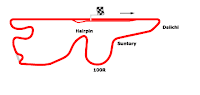 In its current layout, Fuji is a mix of slow corners with the ever inviting super long main straight where cars will top out around 200mph. Although drivers will be full throttle for only 53% of the lap, it is be a test of reliability given the extremes that the engine will face in the rev range from the afore mentioned long straight to the complex of hairpins and chicanes.
Given the location of the track, weather is always a factor and should be on the teams' minds especially given the championship implications. This old circuit even with its modern face lift, will still provide quality racing.
Canadian Grand Prix dropped for 2009
In a move that seemed unexpected, Formula One is not coming to Canada in 2009 thus leaving North America with no F1 races after having dropped the United States Grand Prix several seasons ago. The trend in Formula One has been one of cost cutting and standardizing the series with spec tires and essentially spec engines is the byproduct. Given that North America already has multiple standardized or "spec" series (the American LeMans Series being the notable exception) I suppose that transforming into another spec series simply makes Formula One just part of the landscape.
However, the move to axe Canada should be of no surprise to anyone. All sorts of grand prix have been dumped, shuffled, added or re-added over the years: Spa, Mexico, Imola, United States, Suzuka, etc.; Canada is just another causality in the quest for less expense and more profit in a game in which F1 clearly articulated they were willing to engage in dumping traditional markets for new ones (i.e. Middle East and Asia). Maybe Canada or the United States will end up back on that re-add list when the powers that be eventually take a race from Italy or from France for whatever reason.
I am sure we will get numerous explanations and rationalizations as to why this was done, but simply put, Formula One quit on North America and chose not to compete with NASCAR and other domestic series......cowards.
http://www.fia.com/en-GB/mediacentre/pressreleases/wmsc/wmsc08/Pages/wmsc_071008.aspx
However, the move to axe Canada should be of no surprise to anyone. All sorts of grand prix have been dumped, shuffled, added or re-added over the years: Spa, Mexico, Imola, United States, Suzuka, etc.; Canada is just another causality in the quest for less expense and more profit in a game in which F1 clearly articulated they were willing to engage in dumping traditional markets for new ones (i.e. Middle East and Asia). Maybe Canada or the United States will end up back on that re-add list when the powers that be eventually take a race from Italy or from France for whatever reason.
I am sure we will get numerous explanations and rationalizations as to why this was done, but simply put, Formula One quit on North America and chose not to compete with NASCAR and other domestic series......cowards.
http://www.fia.com/en-GB/mediacentre/pressreleases/wmsc/wmsc08/Pages/wmsc_071008.aspx
Monday, October 6, 2008
It's official: Heidfeld and Kubica at BMW for '09
The BMW Sauber team will retain both Robert Kubica and Nick Heidfeld in the 2009 season, the German squad announced on Monday. The team said Christian Klien will stay on as a test driver. "We see Nick and Robert as a strong driver pairing and Christian as an experienced test driver," said BMW motorsport boss Mario Theissen. "We are in no doubt that we will again achieve our ambitious aims with them in the team's fourth year." The announcement ends weeks of speculation regarding the future of Heidfeld, who was yet to be confirmed at the team.
The confirmation also closes to door to Fernando Alonso, who had been linked with a move to BMW. Now the Spaniard has Renault and Honda as his only options for 2009.
Source: Autosport.com
http://www.autosport.com/news/report.php/id/71185
I think this all but confirms Alonso at Renault in 2009. They clearly see the light at the end of the tunnel given their recent performances and I am sure Alonso sees it as well. He does not need to learn new engineers or new systems even though the resources and the opportunity to work with Ross Brawn is appealing. However, Honda is very much still a wildcard and an unknown quanitity. The way they are finishing the season should leave a lot of doubt in the mind of a quality driver like Alonso.
The confirmation also closes to door to Fernando Alonso, who had been linked with a move to BMW. Now the Spaniard has Renault and Honda as his only options for 2009.
Source: Autosport.com
http://www.autosport.com/news/report.php/id/71185
I think this all but confirms Alonso at Renault in 2009. They clearly see the light at the end of the tunnel given their recent performances and I am sure Alonso sees it as well. He does not need to learn new engineers or new systems even though the resources and the opportunity to work with Ross Brawn is appealing. However, Honda is very much still a wildcard and an unknown quanitity. The way they are finishing the season should leave a lot of doubt in the mind of a quality driver like Alonso.
Friday, October 3, 2008
It's about time they shared the money
Formula One is finally starting to make some sense in terms of really trying to help the smaller teams. The new Formula One Teams' Association (FOTA) is considering this week a restructuring of how the prize money is to be divided. Instead of dividing the money where payments are weighted on a team's final constructors' championship position, they are thinking about dividing the money more equally. Currently, the higher a team finishes in the constructors' championship, the bigger share they get of the estimated $500 million (USD) revenue that is currently given to them by Formula One Management (FOM). Bernie Ecclestone, who heads the FOM proposed and supports this redistribution and it is gaining support from the teams as well.
One team principal source told autosport.com: "This would be a good way of securing the finances of all teams, without hindering those at the front. Teams that win are able to command more sponsorship money than those at the back anyway, so there will always be benefits to winning."
I discussed this money sharing in a September post regarding budget caps in that I said if Formula One is to have an effective cap system there had to be better revenue sharing and if the sport wanted to really save independent teams as well as control costs more effectively, they would give smaller teams an equal share of the TV money to help supplement team budgets. This sort of system is in place in the National Football League (NFL) and in the NFL, everyone makes money and no one is in danger of going bankrupt ala Super Aguri did this season.
This is simply a common sense approach to the growth and sustainability of Formula One and should have been thought about years ago. There is no need for slash and burn cost cutting policies. There just needs to be better sharing the hundreds of millions of dollars that is flowing into the sport.
http://formulaoneamerica.blogspot.com/2008/09/will-budget-cap-work.html
http://www.autosport.com/news/report.php/id/71079
One team principal source told autosport.com: "This would be a good way of securing the finances of all teams, without hindering those at the front. Teams that win are able to command more sponsorship money than those at the back anyway, so there will always be benefits to winning."
I discussed this money sharing in a September post regarding budget caps in that I said if Formula One is to have an effective cap system there had to be better revenue sharing and if the sport wanted to really save independent teams as well as control costs more effectively, they would give smaller teams an equal share of the TV money to help supplement team budgets. This sort of system is in place in the National Football League (NFL) and in the NFL, everyone makes money and no one is in danger of going bankrupt ala Super Aguri did this season.
This is simply a common sense approach to the growth and sustainability of Formula One and should have been thought about years ago. There is no need for slash and burn cost cutting policies. There just needs to be better sharing the hundreds of millions of dollars that is flowing into the sport.
http://formulaoneamerica.blogspot.com/2008/09/will-budget-cap-work.html
http://www.autosport.com/news/report.php/id/71079
Thursday, October 2, 2008
Formula One and the credit crunch
The trouble in the global economy has hit many institutions and businesses. Formula One is not immune to the financial down turn in the world. Here is an interesting article by Alan Baldwin of the International Herald Tribune (Global Edition of the New York Times) regarding Formula One and the credit crunch. For the sake of full information, below is the full article:
Formula One looked in fine fettle at Sunday's stunning night-time grand prix in Singapore but the worry lines are always more apparent in the cold light of day. Money is the lifeblood of the billion-dollar sport and, with the credit crunch biting deep into the global economy, those involved know they cannot continue to spend like there is no tomorrow. "Formula One is in rude good health...and I think that it can stay in great health provided that we take action," Williams team chief executive Adam Parr told Reuters. "Formula One is marketing itself very well in terms of establishing new races in key areas but we need to do more. "Costs have grown exponentially in the last 10 years and it's time to put an end to that."
International Automobile Federation (FIA) president Max Mosley warned in July that Formula One was "becoming unsustainable" and the global economic climate has only deteriorated since then. Honda-backed Super Aguri folded in May, leaving Formula One with 10 teams and no prospect of anyone new coming in. Some insiders fear others could also head for the exit unless changes are made. Toro Rosso, co-owned by Red Bull energy drink billionaire Dietrich Mateschitz, have a guaranteed budget for 2009 but their future remains uncertain beyond that. Red Bull Technology currently design the cars for both Toro Rosso and Red Bull Racing but in 2010 each team will be required to design and make their own, a huge burden for the smaller, Italy-based outfit. "I would struggle to carry on alone," Toro Rosso co-owner Gerhard Berger told Italy's Gazzetta dello Sport last month. "I need the backing of a car manufacturer. Which isn't there."
DWINDLING SALES
Red Bull use their two teams to promote and sell their product while Force India are bankrolled by aviation and drinks billionaire Vijay Mallya, who says he is in for the long haul. Williams, the only team without a manufacturer or billionaire behind them, reported losses of 21.4 million pounds for 2007 on Tuesday but said they were well-funded for the future. In a sport where sponsorship contracts are generally negotiated to run for three and sometimes five years, and spaced out to ensure they do not all expire at once, the former champions can expect to weather the immediate storm.
However big-spending manufacturer teams may be more vulnerable to the parent company's board looking at the bottom line and deciding enough is enough. "It's a lot of money that can be addressed with one swish of the red pen," said Parr. BMW, Fiat (Ferrari), Honda, Mercedes (McLaren), Renault and Toyota all either wholly or part own teams -- some with budgets of more than 226 million pounds a year -- against a backdrop of dwindling sales and sinking share prices. Some, such as Toyota, have pumped billions of dollars into the sport with little to show for their investment. Honda, whose car promotes environmental awareness rather than any major external sponsor, have also spent hugely.
MORE PRESSURE
"Those teams that are very dependent on car manufacturers for funding and don't have commercial sponsors might be under more pressure," former Benetton and BAR team boss David Richards told Reuters. But there is unlikely to be any knee-jerk reaction. It (withdrawal) is such a high-profile decision to make." To try to bring down the costs, the teams have formed an association to work with the FIA and commercial rights holders. "I think it is absolutely urgent," Parr said of the need for cost-cutting. "Whatever measures we take must be in place for 2010. Anything beyond that is too late, both the teams and the FIA recognise that. "The car manufacturers could halve their spending in Formula One tomorrow," he added. "I know that because, guess what, I know what we are spending. Why does anyone have to spend more than Williams spend on going racing? If the board of another team says we want to stay in F1 because it's a fantastic platform for our business but we are only prepared to spend what Williams spends -- is that the end of the world? Some of these teams could save 100 or 200 million euros by doing that."
On the plus side, the money is pouring in from new venues such as Singapore and Abu Dhabi, which will make its debut in 2009, and there is no immediate sign of sponsors running for cover.
"I think we had 900 guests over the Singapore weekend. Our sponsors were enormously active," said Parr, who added that three or four partners had renewed or extended contracts in the last few weeks. "Businesses still have to achieve their key objective and Formula One is still a unique platform for doing that," he said.
"For a company worth let's say 40 billion pounds, to invest 20 million a year in a Formula One partnership is not a major undertaking. It's significant but not major."
International Herald Tribune
http://www.iht.com/articles/reuters/2008/10/02/sports/OUKSP-UK-MOTOR-RACING-MONEY.php?page=1
Formula One looked in fine fettle at Sunday's stunning night-time grand prix in Singapore but the worry lines are always more apparent in the cold light of day. Money is the lifeblood of the billion-dollar sport and, with the credit crunch biting deep into the global economy, those involved know they cannot continue to spend like there is no tomorrow. "Formula One is in rude good health...and I think that it can stay in great health provided that we take action," Williams team chief executive Adam Parr told Reuters. "Formula One is marketing itself very well in terms of establishing new races in key areas but we need to do more. "Costs have grown exponentially in the last 10 years and it's time to put an end to that."
International Automobile Federation (FIA) president Max Mosley warned in July that Formula One was "becoming unsustainable" and the global economic climate has only deteriorated since then. Honda-backed Super Aguri folded in May, leaving Formula One with 10 teams and no prospect of anyone new coming in. Some insiders fear others could also head for the exit unless changes are made. Toro Rosso, co-owned by Red Bull energy drink billionaire Dietrich Mateschitz, have a guaranteed budget for 2009 but their future remains uncertain beyond that. Red Bull Technology currently design the cars for both Toro Rosso and Red Bull Racing but in 2010 each team will be required to design and make their own, a huge burden for the smaller, Italy-based outfit. "I would struggle to carry on alone," Toro Rosso co-owner Gerhard Berger told Italy's Gazzetta dello Sport last month. "I need the backing of a car manufacturer. Which isn't there."
DWINDLING SALES
Red Bull use their two teams to promote and sell their product while Force India are bankrolled by aviation and drinks billionaire Vijay Mallya, who says he is in for the long haul. Williams, the only team without a manufacturer or billionaire behind them, reported losses of 21.4 million pounds for 2007 on Tuesday but said they were well-funded for the future. In a sport where sponsorship contracts are generally negotiated to run for three and sometimes five years, and spaced out to ensure they do not all expire at once, the former champions can expect to weather the immediate storm.
However big-spending manufacturer teams may be more vulnerable to the parent company's board looking at the bottom line and deciding enough is enough. "It's a lot of money that can be addressed with one swish of the red pen," said Parr. BMW, Fiat (Ferrari), Honda, Mercedes (McLaren), Renault and Toyota all either wholly or part own teams -- some with budgets of more than 226 million pounds a year -- against a backdrop of dwindling sales and sinking share prices. Some, such as Toyota, have pumped billions of dollars into the sport with little to show for their investment. Honda, whose car promotes environmental awareness rather than any major external sponsor, have also spent hugely.
MORE PRESSURE
"Those teams that are very dependent on car manufacturers for funding and don't have commercial sponsors might be under more pressure," former Benetton and BAR team boss David Richards told Reuters. But there is unlikely to be any knee-jerk reaction. It (withdrawal) is such a high-profile decision to make." To try to bring down the costs, the teams have formed an association to work with the FIA and commercial rights holders. "I think it is absolutely urgent," Parr said of the need for cost-cutting. "Whatever measures we take must be in place for 2010. Anything beyond that is too late, both the teams and the FIA recognise that. "The car manufacturers could halve their spending in Formula One tomorrow," he added. "I know that because, guess what, I know what we are spending. Why does anyone have to spend more than Williams spend on going racing? If the board of another team says we want to stay in F1 because it's a fantastic platform for our business but we are only prepared to spend what Williams spends -- is that the end of the world? Some of these teams could save 100 or 200 million euros by doing that."
On the plus side, the money is pouring in from new venues such as Singapore and Abu Dhabi, which will make its debut in 2009, and there is no immediate sign of sponsors running for cover.
"I think we had 900 guests over the Singapore weekend. Our sponsors were enormously active," said Parr, who added that three or four partners had renewed or extended contracts in the last few weeks. "Businesses still have to achieve their key objective and Formula One is still a unique platform for doing that," he said.
"For a company worth let's say 40 billion pounds, to invest 20 million a year in a Formula One partnership is not a major undertaking. It's significant but not major."
International Herald Tribune
http://www.iht.com/articles/reuters/2008/10/02/sports/OUKSP-UK-MOTOR-RACING-MONEY.php?page=1
Wednesday, October 1, 2008
Has Kimi Raikkonen quit already?
In 2007, after years of unfulfilled promise and misfortune Kimi Raikkonen grabbed his first World Championship in improbable and spectacular fashion. He was expected to win it when he signed for Ferrari and although it looked like that promise was again to be unfulfilled he beat the McLaren duo of Fernando Alonso and Lewis Hamilton by a single point. It was also expected that the flood gates would open for a run of Raikkonen titles; many predicted that he was going to repeat as champion in 2008. However, he has fallen way short of expectations and currently is receiving the worst beating of his career from a teammate. Given the many rumors that persisted that he was retiring, one must ask the questions even though his contract is extended to after 2010, has Raikkonen retired already? Is he suffering from a lack of motivation?
As mentioned, Ferrari recently put an end to the retirement speculation by signing Raikkonen to an extension. Nevertheless, his performance this year looks to be more than a driver simply struggling with the car. Raikkonen has always been a bit of an enigma to me and always needed some external motivation. I felt that he lacked the motivation to work on his car development skills or adjust his driving style, which in my opinion ultimately led to his defeat in 2005 to Alonso and Renault. He again is showing that lack of motivation when it comes to solving how to get the best from his tires. One would think that he would put more effort into testing. It continues to be the case, that his teammates test more frequently and amass more mileage than Raikkonen. This was similar at McLaren. To me this is the difference that makes Alonso a multiple world champion and able to help a struggling Renault win again.
Raikkonen clearly still has the speed to dominate the field as he has posted 10 fastest laps in 2008. If there is a target out there for him to shoot at, I think he can perform in a dominant fashion; but he does not have that now. Raikkonen has all that he ever wanted; he got his dream ride at Ferrari, he has won a championship and Raikkonen makes no secret that he does not live and breath racing and does not want to stay forever. He currently sits fourth in the World championship in a car that is more than capable of winning the title and appears rather uninterested. When Raikkonen has been focused he simply does not make any mistakes. However, in the years in which his motivation and focus is questionable (2006 and 2008) he has made uncharacteristic errors and has crashed out or spun off. If we look at Raikkonen from 2001-2005, the number of crashes and spins for Raikkonen is 6 (for races). In 2006 and 2008, again years that motivation was questionable, he crashed or spun 7 times and 2008 is not over yet. So, in 2 seasons he has spun or crashed more than he ever did in 5 years. What makes these 2 seasons important is that he knew he was off to Ferrari in 2006 while he drove a lackluster McLaren and in 2008 he comes off a championship season and has to quiet rumors about his retirement. In these circumstances it is rather easy to be demotivated. For record, in 2007 he was error free in terms of spins or crashes in races. You can draw some parallels with another Ferrari driver Jody Scheckter, who after years of trying, won the Formula 1 championship in 1979. He quit after a dismal 1980. However, his fall from grace was substantially worse than anything Raikkonen would do.
Raikkonen has received the benefit of the doubt from Ferrari president Luca di Montezemolo. I suppose when you win a title you have earned a reprieve. I believe if this was Felipe Massa in the position of not scoring a single point in 4 straight races and having spun off in two of them, and there had been sustained rumors of retirement, which Raikkonen has done, people would have considered it a scandal that Massa was still driving arguable the best car on the grid.
Let us see if Kimi can turn it around because it would be a shame for a driver in his prime years just fluff all that natural talent away.
As mentioned, Ferrari recently put an end to the retirement speculation by signing Raikkonen to an extension. Nevertheless, his performance this year looks to be more than a driver simply struggling with the car. Raikkonen has always been a bit of an enigma to me and always needed some external motivation. I felt that he lacked the motivation to work on his car development skills or adjust his driving style, which in my opinion ultimately led to his defeat in 2005 to Alonso and Renault. He again is showing that lack of motivation when it comes to solving how to get the best from his tires. One would think that he would put more effort into testing. It continues to be the case, that his teammates test more frequently and amass more mileage than Raikkonen. This was similar at McLaren. To me this is the difference that makes Alonso a multiple world champion and able to help a struggling Renault win again.
Raikkonen clearly still has the speed to dominate the field as he has posted 10 fastest laps in 2008. If there is a target out there for him to shoot at, I think he can perform in a dominant fashion; but he does not have that now. Raikkonen has all that he ever wanted; he got his dream ride at Ferrari, he has won a championship and Raikkonen makes no secret that he does not live and breath racing and does not want to stay forever. He currently sits fourth in the World championship in a car that is more than capable of winning the title and appears rather uninterested. When Raikkonen has been focused he simply does not make any mistakes. However, in the years in which his motivation and focus is questionable (2006 and 2008) he has made uncharacteristic errors and has crashed out or spun off. If we look at Raikkonen from 2001-2005, the number of crashes and spins for Raikkonen is 6 (for races). In 2006 and 2008, again years that motivation was questionable, he crashed or spun 7 times and 2008 is not over yet. So, in 2 seasons he has spun or crashed more than he ever did in 5 years. What makes these 2 seasons important is that he knew he was off to Ferrari in 2006 while he drove a lackluster McLaren and in 2008 he comes off a championship season and has to quiet rumors about his retirement. In these circumstances it is rather easy to be demotivated. For record, in 2007 he was error free in terms of spins or crashes in races. You can draw some parallels with another Ferrari driver Jody Scheckter, who after years of trying, won the Formula 1 championship in 1979. He quit after a dismal 1980. However, his fall from grace was substantially worse than anything Raikkonen would do.
Raikkonen has received the benefit of the doubt from Ferrari president Luca di Montezemolo. I suppose when you win a title you have earned a reprieve. I believe if this was Felipe Massa in the position of not scoring a single point in 4 straight races and having spun off in two of them, and there had been sustained rumors of retirement, which Raikkonen has done, people would have considered it a scandal that Massa was still driving arguable the best car on the grid.
Let us see if Kimi can turn it around because it would be a shame for a driver in his prime years just fluff all that natural talent away.
Subscribe to:
Posts (Atom)